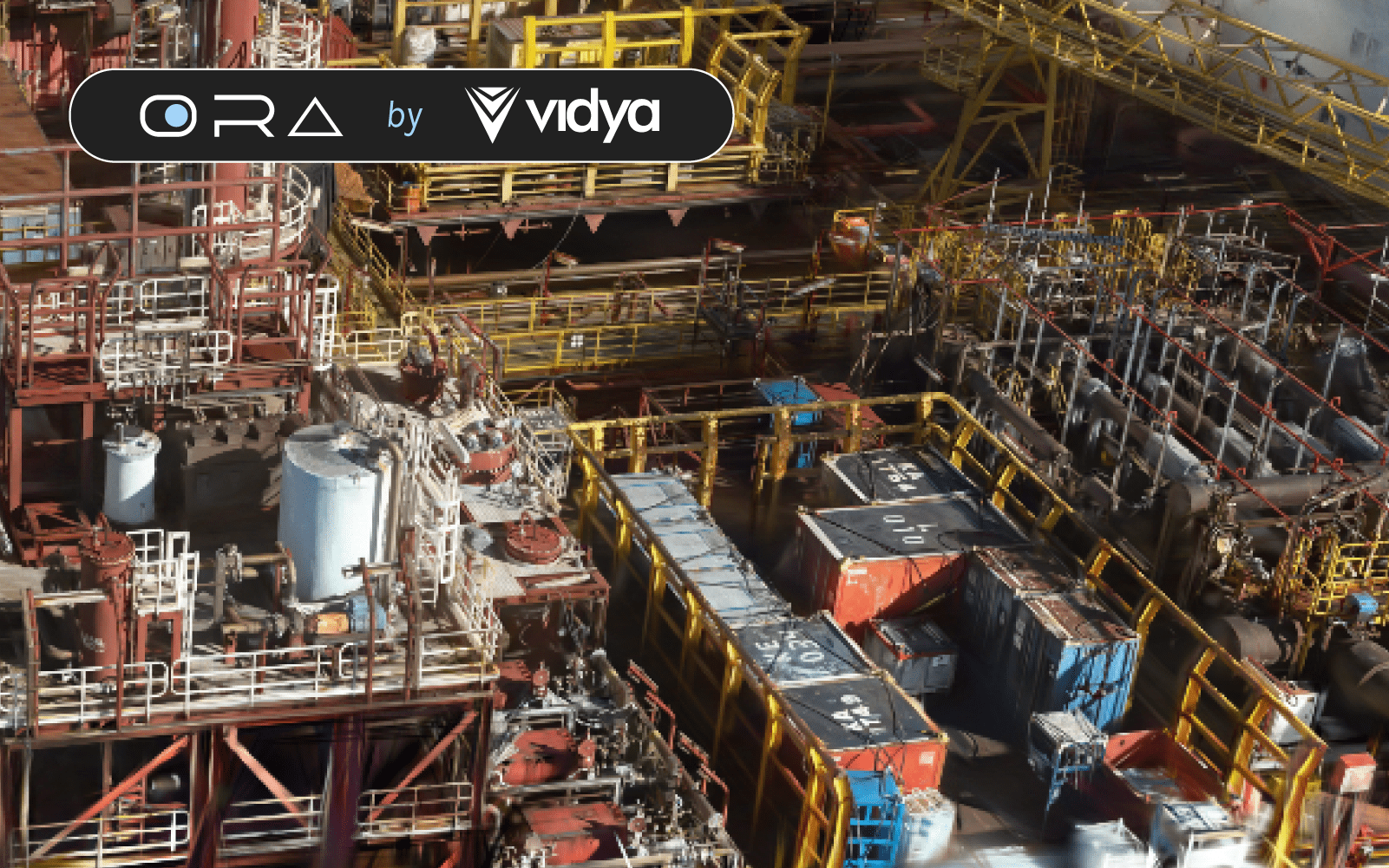
Navigating complex environments, whether they are industrial plants, preservation sites, or hard-to-reach cultural landmarks, often involves significant logistical challenges and safety risks. From remote locations and confined spaces to weather exposure or fragile structures, many environments are difficult to access, document, or monitor regularly. In sectors like process industries, infrastructure, construction, tourism, and heritage conservation, obtaining an accurate spatial understanding of these environments typically requires on-site presence, specialized equipment, and significant resource investment.
But what if there were another way? What if entire operational or historical spaces could be reconstructed using nothing more than a set of images, enabling remote, immersive access without setting foot on site?
With the release of Ora Viewer, Vidya introduces a photorealistic Spatial Computing tool that allows anyone to navigate real-world spaces in 3D using only a web browser. Powered by advanced image-based reconstruction and Gaussian Splatting, Ora Viewer bypasses the limitations of traditional 3D modeling workflows, delivering a new level of immersion, visual detail, and accessibility to a wide range of applications.
Behind the Ora Viewer: Spatial Computing
At the core of Ora Viewer is the concept of Spatial Computing, a space reconstruction technology that enables digital systems to recreate and interpret real-world environments in three dimensions. Rather than recreating virtual 3D scenarios from scratch, Spatial Computing captures the actual appearance and structure of physical spaces through sparse images, reconstructing the scene in a way that preserves spatial relationships, surface details, and depth perception.
Spatial Computing bridges the gap between real-world complexity and digital accessibility, removing physical limitations from planning, inspection, collaboration, action, and decision-making. To achieve this level of realism and responsiveness, Ora Viewer employs Gaussian Splatting. According to Chen and Wang (2024), this method reconstructs 3D environments by placing a dense cloud of tiny, semi-transparent shapes, called Gaussians, throughout the virtual space. Each Gaussian carries information about its position in 3D space, its color, how sharp or blurry it appears, and how it fades at the edges. When viewed together, these elements form a smooth, lifelike digital reconstruction of the real environment.
Unlike other space reconstruction methods that rely on triangle meshes or fixed geometric models, Gaussian Splatting uses these overlapping “splats” to naturally capture surface textures, lighting variations, and even subtle transitions between materials. This makes the resulting 3D scene look and feel far more realistic, especially in contexts where complex surfaces and tight geometries are common. Beyond that, these Gaussians are not all identical in shape; they can stretch in different directions, which helps them adapt to the contours of physical structures. This property is known as anisotropy, and it plays a key role in capturing fine visual detail and depth perception, as highlighted by Chen & Wang (2024).
Furthermore, the Gaussian Splatting process begins by feeding a set of overlapping photographs into a rendering system that calculates where in space these Gaussians should be placed and how they should appear. As users move through the scene, the viewer renders only the Gaussians visible from that angle, resulting in real-time performance even for large, detailed environments. Wu et. al (2024) stated that besides this approach producing photorealistic visuals, it also allows for interactive navigation at high frame rates, making the entire process faster, more flexible, and more accessible to industrial teams.
How the Ora Viewer impacts different Areas
Although the Ora Viewer was initially developed for industrial applications, its ability to reconstruct spaces with photorealistic fidelity has unlocked transformative possibilities in other fields. From promoting cultural heritage to expanding access to remote landmarks and supporting long-term conservation efforts, Ora Viewer delivers more than just digital replicas; it enables a deeper understanding of space, structure, and history. Below, we explore how the technology is already making an impact across different areas.
Tourism & Historical Preservation
Cultural heritage sites are typically crowded, time-sensitive, and often subject to environmental degradation or urban transformation. The Ora Viewer provides the means to digitally preserve these spaces in full detail, creating a long-lasting, navigable 3D archive that captures not only the appearance but also the spatial atmosphere of a site.
Using drone imagery or handheld photography, historical buildings, monuments, and public spaces can be reconstructed with a level of detail suitable for documentation, education, and even restoration planning. These digital models can serve as chronological records, tracking changes over time, and supporting conservation decisions with clear visual evidence.
Beyond preservation, the Ora Viewer also supports education and cultural engagement. Museums, schools, and heritage organizations can use it to create interactive learning experiences, allowing students or visitors to explore historically significant locations virtually while accessing contextual information embedded directly within the environment.
Besides that, the Ora Viewer also enhances accessibility. Individuals who are geographically distant, physically unable to travel, or simply planning a future visit can now interact with renowned destinations in real time, observing artwork, architecture, and natural beauty from any angle. This expands the reach of tourism far beyond the physical location, turning global landmarks into digitally accessible cultural assets.
Industrial applications
The Ora Viewer enables teams to explore operational areas virtually with a level of spatial awareness that surpasses traditional imagery and sensing methods. This technology is a browser-based platform that transforms sets of high-resolution photographs into fully navigable, photorealistic 3D environments. By leveraging advanced space reconstruction techniques such as Gaussian Splatting, Ora Viewer creates a powerful visual interface that expands what operational Digital Twin can do, without the need for laser scans or CAD models.
In these conditions, the system functions by processing sets of overlapping images or video frames to reconstruct real 3D environments. Once generated, the 3D environment allows users to move freely within the scene, examining structures from any perspective, zooming into details, and visually inspecting asset conditions in ways that static images or conventional reports simply cannot match. This immersive experience brings industrial facilities to life, offering unprecedented clarity for planning, inspection, or collaborative review.
Besides that, the Ora Viewer eliminates the need for laser scanning or other resource-heavy data acquisition methods. By using only overlapping photographic inputs, it drastically simplifies the modeling pipeline and accelerates the software deployment. This not only reduces cost and lead time but also opens the door for more frequent updates, enabling near real-time visual monitoring of asset conditions even in high-traffic or logistically complex sites.
The technology has also proven adaptable to segmentation and structural recognition tasks. Vidya’s Tech Lead, Vinicius Bartolomeu (2024), demonstrated in a recent study how Gaussian Splatting can be extended beyond visual immersion to support semantic segmentation of industrial components, such as pipes and valves, using AI-driven models like SAM (Segment Anything Model) and CLIP. These advancements suggest a near future in which platforms like Ora Viewer can automatically detect, label, and monitor critical infrastructure elements with minimal human input, transforming how inspections, maintenance planning, and compliance tracking are conducted across sectors.
“Validation of Gaussian Splatting across diverse datasets, ranging from controlled industrial images to public scenes, demonstrates the method’s robustness across multiple use cases (Bartolomeu & Menotti, 2024).”
Scalable across asset types and sizes, the Ora Viewer is equally effective whether capturing a small equipment room or an entire topside module. Its rendering quality remains consistent regardless of complexity, supporting detailed analysis and decision-making for operations, maintenance, and engineering teams alike.
Beyond Digital Twins
Digital Twins have become an essential tool across sectors for representing and managing assets in a digital environment. Typically, these models use geometric representations such as CAD drawings, BIM files, or point clouds, enriched with structured data like technical specifications, maintenance records, or sensor inputs. They are widely used to simulate behavior, monitor performance, and centralize data for decision-making.
However, most Digital Twins remain visually abstract. They are powerful for data analysis but limited when it comes to realistic spatial representation. They don’t show how a place looks or feels, especially when visual context matters for understanding, planning, or engaging with a space.
Ora Viewer builds upon and extends these capabilities through Spatial Computing. It reconstructs not just the functional model of an environment, but its actual visual and geometric reality, transforming high-resolution photos into immersive 3D spaces that can be explored and analyzed. From industrial facilities to archaeological sites, remote communities, or tourist destinations, this type of reconstruction allows users to visually experience and navigate real spaces with photorealistic clarity.
This doesn’t replace the Digital Twin; it enhances it. In fact, Spatial computing platforms like Ora Viewer can serve as a visual and contextual layer on top of Digital Twin infrastructures. Indexed data such as inspection notes, historical information, visitor interactions, AI-based annotations, or restoration records can all be integrated into the viewer, creating a single visual interface that unifies information and experience.
This shift toward visually rich, context-aware environments helps make complex spaces more intuitive and accessible. Whether you’re monitoring corrosion on a production platform, guiding virtual tourists through preserved architecture, or evaluating the structural layout of a building before restoration, Ora Viewer gives users the ability to engage with real spaces remotely, accurately, and visually.
A Growing Market for Spatial Awareness
According to Gartner, the global Spatial Computing market is expected to grow from $110 billion in 2023 to $1.7 trillion by 2033, driven by a growing need for context-rich digital environments, especially in industries where accuracy and operational safety are a priority. Thus, as digital transformation and virtual collaboration become standard, tools like Ora Viewer offer a practical, scalable way to meet these demands without overhauling legacy systems or investing in
Moreover, spatial computing technologies are increasingly intersecting with AI and automation, unlocking new layers of intelligence within industrial environments. Ora Viewer is already evolving in that direction, with upcoming features like automatic anomaly detection, AI-assisted defect tagging, and in-view measurements that will further integrate visual data with operational decision-making.
Conclusion
As organizations move toward more connected, data-driven operations, Ora Viewer represents a foundational step in digitizing physical space, not through idealized simulations, but through true-to-life, high-resolution reconstructions that are easy to generate, update, and share. Its browser-based nature, scalability, and photorealistic rendering make it an accessible yet powerful layer to complement Digital Twins, engineering tools, and enterprise systems.
About the Author: Jorge Kawano