Turnover rarely extends because tasks are technically difficult. It extends because teams do not fully trust the information they are handed. Too often, turnover is treated as a short, procedural, and largely administrative step: a final checkbox before responsibility shifts to the next stakeholder. Yet, in practice, they are some of the most fragile moments in an asset’s lifecycle. Decisions made under time pressure, with incomplete visibility, determine whether an asset returns to service with confidence or with unresolved uncertainty quietly embedded into operations.
So why do turnover cycles so often stretch beyond plan, even when execution is complete, and documentation is delivered? Why do teams hesitate at the very moment when responsibility is supposed to be clearly transferred? These questions point to deeper structural issues that go beyond schedules, manpower, or individual discipline performance. Understanding what really slows turnover requires looking at how information is produced, accessed, and trusted at the boundary between planning, execution, and operation.
What Are Turnover Cycles in Large-Process Industries
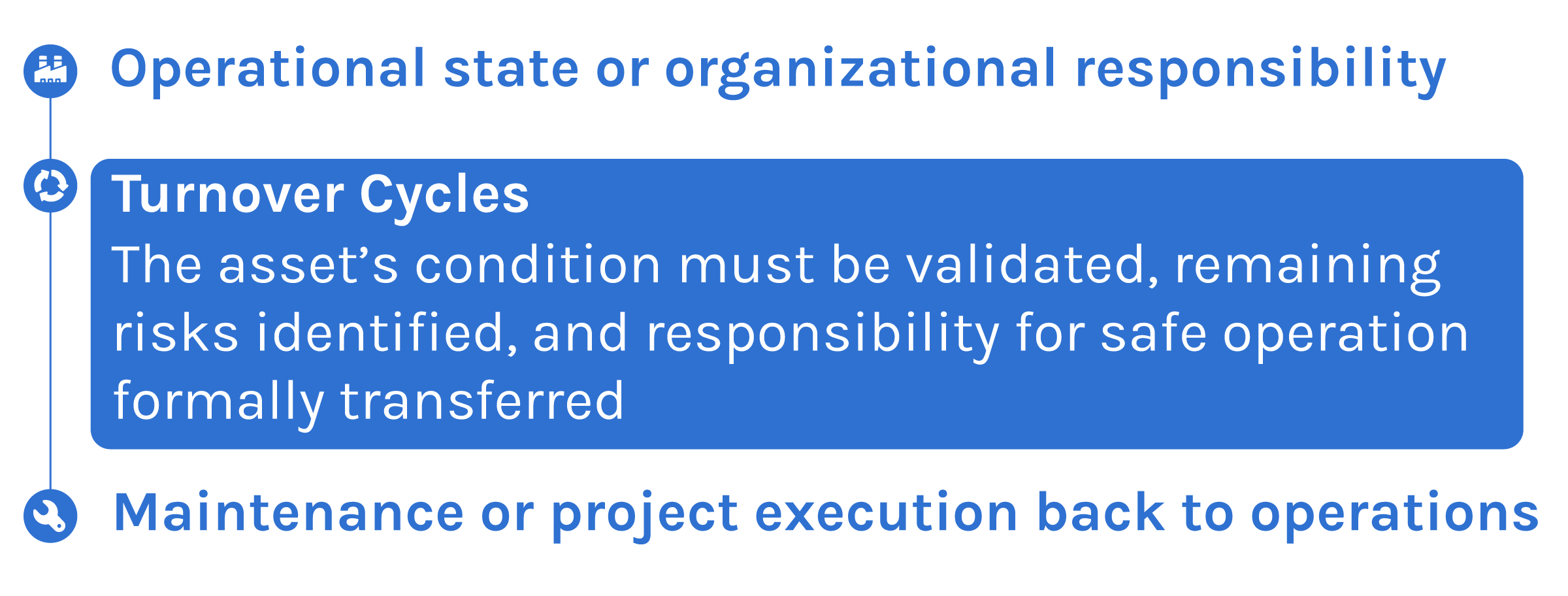
A turnover cycle represents the transitional phase in which an industrial asset moves from one operational state or organizational responsibility to another, most commonly from maintenance or project execution back to operations. During this phase, the asset’s condition must be validated, remaining risks identified, and responsibility for safe operation formally transferred. Although often treated as a procedural formality, turnover is in fact a critical decision point in the asset lifecycle, with direct implications for safety, reliability, and production continuity.
Turnover cycles are frequently confused with turnarounds, but the distinction is fundamental. Turnarounds are large-scale shutdown events, governed by extensive planning, dedicated resources, and well-defined scopes. Turnover cycles, by contrast, occur far more often and under significantly tighter time constraints. They take place at the boundary between execution and operation, where pressure to restart production competes with the need to confirm that assets are truly fit for service. This tension is precisely what makes turnover so vulnerable to delay.
Besides that, it is important to clarify that turnover cycles are unrelated to employee turnover. In the large-process industry context, turnover refers not to people leaving the organization, but to assets changing hands. Responsibility shifts from one team to another, and with it, accountability for asset integrity. When the information supporting this transfer is incomplete, fragmented, or poorly contextualized, confidence erodes.
A typical turnover cycle involves the review of inspection results, verification of executed work orders, assessment of outstanding anomalies or temporary repairs, and confirmation that documentation reflects the actual, as-built condition of the asset. These activities are intended to provide a clear and shared understanding of readiness for operation. In practice, however, they often trigger revalidation efforts that extend schedules and dilute accountability.
Why Turnover Cycles Become Longer Than Planned
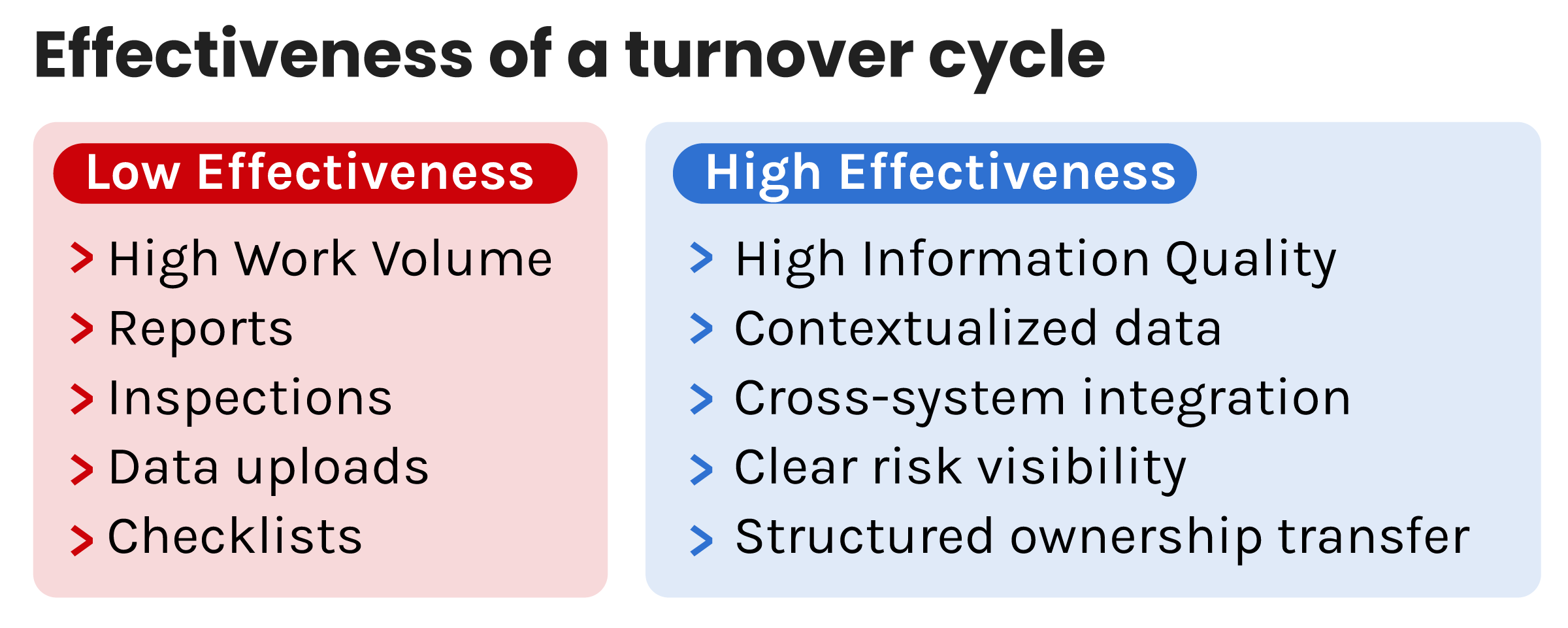
Turnover cycles are rarely treated as a management responsibility. Instead, they are assumed to be concluded once execution activities are completed and documentation is delivered. In reality, the effectiveness of a turnover cycle is determined not by the volume of work performed but by the quality, accessibility, and contextualization of the information that supports the transfer of ownership. When this information is fragmented, unevenly accessible, or detached from the physical asset, turnover shifts from a structured decision point into a prolonged phase of verification and hesitation. The challenges discussed below reflect the structural reasons why turnover cycles frequently extend beyond the plan.
Fragmented Asset and Integrity Data
One of the most persistent challenges in managing turnover cycles is the fragmentation of asset and integrity information across systems, disciplines, and formats. In large industrial facilities, this challenge is compounded not only by the sheer volume of data generated throughout the asset lifecycle. Data required to assess readiness for service, such as inspection findings, risk studies, corrosion assessments, work orders, and deviation records, is produced continuously by multiple stakeholders and stored in different environments. As a result, despite the abundance of information, it is rarely available as a coherent and validated whole. Instead, teams must navigate multiple tools and repositories, each offering only a partial view of the asset’s condition at the moment of handover.
Even though standards such as ISO 15926 were developed to address interoperability issues between proprietary engineering data schemas, fragmentation remains the norm in industrial environments. Core engineering information, such as process diagrams, technical datasheets, and user manuals, remains fragmented and heterogeneous in the form of 2D documents and 3D drawings (Rasys, E. et al., 2014). Information may exist, but not in a structure that supports rapid synthesis or validation, increasing dependence on manual interpretation and cross-referencing.

Isolated Access to Information
Beyond fragmentation at the data level, turnover cycles are further complicated by isolated access to information across organizational boundaries. Engineering, inspection, maintenance, and operations often rely on different systems and datasets, each optimized for local tasks rather than shared decision-making. Even when information exists, it is not equally visible, interpretable, or connected across teams.
During turnover, this disconnect becomes particularly visible. Rather than relying on a unified representation of asset condition, teams are forced to manually reconstruct the integrity narrative by cross-referencing documents, revalidating inspection results, and confirming previously approved work. The effort invested is not directed toward resolving new technical issues, but toward compensating for limitations in how information is accessed and shared.
This pattern transforms turnover into a process of accumulated verification rather than controlled handover. According to Pakkala (2024), asset management suffers from data accessibility, completeness, consistency, and interoperability issues that require manual validation and reconciliation work. Responsibility is not transferred through a shared understanding of asset condition, but through successive layers of reassurance. The consequence is a structural inefficiency in how asset knowledge is accessed, interpreted, and trusted at the moment of operational transfer.
Lack of spatial context
Even when integrity data exists, it is often presented without adequate spatial context. Reports describe findings in text, tables, or static images, leaving teams to interpret where issues are located, how they relate to surrounding equipment, and whether they impact operability. This disconnect between data and physical reality becomes especially problematic during turnover, when decisions must be made quickly and with limited tolerance for ambiguity.
Without spatially contextualized asset intelligence, teams struggle to assess readiness for service holistically. A corrosion note, an open anomaly, or a temporary repair may appear minor in isolation, but its true significance only becomes clear when viewed in relation to the asset’s geometry and operational environment. In the absence of this context, organizations default to conservative assumptions, additional verification steps, and delayed approvals.
The Role of Digitization in Turnover Cycles
Fragmented datasets, isolated access, and the absence of spatial context all point to the same underlying problem: decisions during turnover are made without a unified, trustworthy representation of asset condition. Digitization, when applied at the integrity and asset level, directly addresses this limitation by reshaping how information supports operational transfer. Indeed, organizations with higher digital maturity demonstrate faster and more coordinated decision-making by enabling shared access to consistent, contextualized information across engineering, operations, and maintenance functions (Deloitte, 2024).
In this digitized context, documentation and operational data are no longer evaluated in isolation, but as part of a coherent representation of asset condition. This integration reduces the time required to assemble information, eliminates repeated validation steps, and enables readiness assessments to be performed earlier and with greater clarity. Digitization also accelerates turnover by enabling simultaneous access to the same operational view. Different disciplines don’t have to wait for clarifications or reconciliations from other teams. Instead, decisions can be made in parallel, based on a shared understanding of asset status.
Besides that, spatially contextualized asset intelligence shortens turnover by improving interpretation speed with 3D asset models as the foundation for locating anomalies, degradation mechanisms, and outstanding issues. When integrity data is directly linked to a spatial representation of the asset, it is no longer abstract. Teams can immediately see where a problem is, what it affects, and how it relates to surrounding systems and operational boundaries. This eliminates ambiguity, reduces conservative assumptions, and minimizes the need for additional field verification.
How Vidya Supports Turnover Cycle Reduction
Furthermore, Vidya Technology, a company specialized in digital solutions for large-process industries, developed an Asset Integrity Management (AIM) approach that addresses turnover inefficiencies by establishing a unified digital foundation where integrity information, operational data, and spatial context converge. Rather than treating inspections, risk assessments, and documentation as independent deliverables, Vidya structures them as interconnected elements of a single asset-centric environment, reducing turnover cycles in up to 74%. This shift is fundamental for turnover cycles, where the speed and quality of decisions depend on how quickly teams can form a reliable understanding of asset condition.
At the core of this approach is the contextualization of all operational data into one single framework. On one side, there is structured data: systems and sources that are already organized and digitized, such as IT and OT systems, CMMS, ERP, EDMS, PIMS, and even existing 3D models. On the other side, there is unstructured data, which represents a large portion of the reality of operations: scans, photos, technical reports, spreadsheets, engineering documents, and P&IDs. By themselves, these two categories of data exist in silos and rarely interact with each other in a way that produces value for daily operations.
This is where Vidya’s Digital Twin acts as a central engine. Structured and unstructured information is ingested, processed, and correlated, transforming raw inputs into a single connected platform. In these conditions, the previous fragmented datasets are contextualized in relation to each other, providing reliable access, traceability, and cross-functional collaboration to all stakeholders. In practice, this translates into the ability to:
- Monitor turnover progress in real time, with visibility into the status of each activity, pending items, and resolved anomalies
- Track anomaly lifecycle, ensuring that findings are not only identified but verified as effectively mitigated before handover
- Integrate previously disconnected processes, reducing duplication of work and preventing conflicting or redundant maintenance and integrity actions
- Enable collaborative workflows across engineering, maintenance, inspection, integrity, and operations within a shared environment
- Eliminate rework caused by information gaps, such as repeated painting, inspections, or corrective tasks due to a lack of execution traceability
- Provide coordinated planning and execution of field activities through mobile applications connected to the central platform
- Anchor all integrity and operational data to spatial context, allowing precise localization of risks and interventions in 3D models
- Visualize risk criticality through 3D heatmaps, supporting prioritization and faster decision-making
- Ensure document traceability, version control, and audit readiness, supporting regulatory compliance (e.g., IEC 60079, NEC 500/505, ISO 80079)
Conclusion
Turnover cycles expose a fundamental truth about large-process industries: operational readiness is not defined by the completion of tasks, but by the ability to confidently understand asset condition at the moment responsibility changes hands. When information is fragmented, isolated, or detached from physical reality, organizations compensate with caution, repetition, and delay. These behaviors are rational responses to uncertainty, but they quietly extend turnover and dilute accountability.
Reducing turnover duration, therefore, is not about accelerating procedures or compressing reviews. It is about changing the conditions under which decisions are made. When integrity data, documentation, and spatial context converge into a single operational view, turnover stops being a leap of faith and becomes a controlled transition.
About the Author: Jorge Kawano