


Digital Process Safety Application2026-03-17T14:40:40+00:00

Digital Process Safety Application [DPS]

Turn fragmented safety data into operational clarity.

Risk studies, safeguards, responsibilities, and follow-up actions are traceable and updated, ensuring that critical controls are understood, maintained, and validated throughout the operational lifecycle.

Digital Process Safety Application [DPS]

Turn fragmented safety data into operational clarity.

Risk studies, safeguards, responsibilities, and follow-up actions are traceable and updated, ensuring that critical controls are understood, maintained, and validated throughout the operational lifecycle.

Built for Oil, Gas and Energy, Chemicals, Marine, Mining Metal Minerals, Manufacturing, Power & Utilities, and Infrastructure.
Where safety, reliability, and performance are non-negotiable.
plinio cantanhede logo - operator in offshore plant

The technical paper on this solution was recognized at ROGe 2024 Congress as the best in Innovation and Digital Transformation in the Plínio Cantanhede Award.

An application like this should be mandatory for anyone operating offshore. It represents the baseline standard to ensure safer and more controlled operations.

Former CENPES CTO,
Petrobras

Using VSP’s field images, we can quickly locate critical reference points, assess safety conditions, and verify equipment directly from the office. It helps us identify potential failures in process safety workflows and evaluate whether the field is ready for necessary changes before mobilizing teams

Process Safety Engineer,
Altera & Ocyan

Impact Generated

  • Reduced information search time by 75%, accelerating planning cycles.

  • Strengthened coordination between planning, field, and safety inspection teams.

  • Reduced OPEX across integrity activities

  • Regulatory compliance

Built for Oil, Gas and Energy, Chemicals, Marine, Mining Metal Minerals, Manufacturing, Power & Utilities, and Infrastructure.
Where safety, reliability, and performance are non-negotiable.

The technical paper on this solution was recognized at ROGe 2024 Congress as the best in Innovation and Digital Transformation in the Plínio Cantanhede Award.

An application like this should be mandatory for anyone operating offshore. It represents the baseline standard to ensure safer and more controlled operations.

Former CENPES CTO,
Petrobras

Using VSP’s field images, we can quickly locate critical reference points, assess safety conditions, and verify equipment directly from the office. It helps us identify potential failures in process safety workflows and evaluate whether the field is ready for necessary changes before mobilizing teams

Process Safety Engineer,
Altera & Ocyan

Impact Generated

  • Reduced information search time by 75%, accelerating planning cycles.

  • Strengthened coordination between planning, field, and safety inspection teams.

  • Reduced OPEX across integrity activities

  • Regulatory compliance

Built Around the Real Needs of Process Safety Professionals
Vidya's System platform document management feature

See risk in context, not in documents


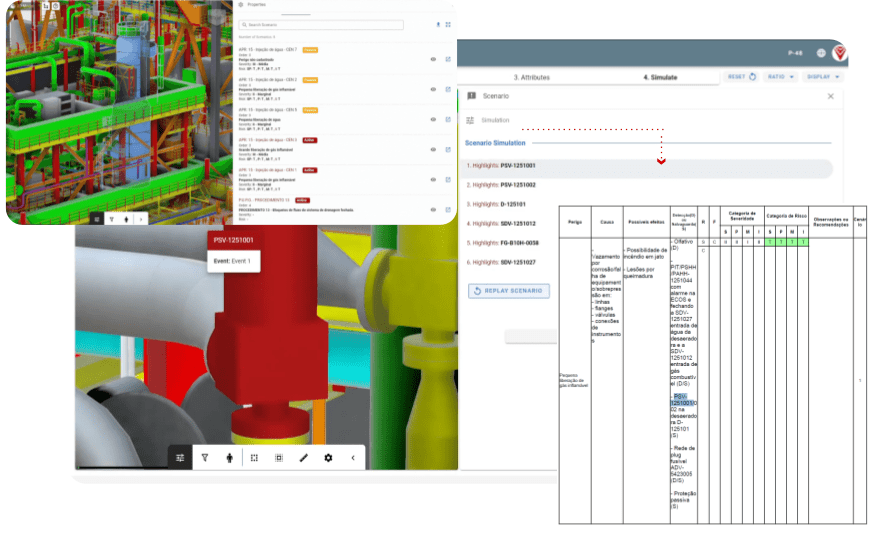
Be aware of everything that could go wrong. The Scenarios feature brings
hazard and risk studies into the Digital Twin, showing what triggers an event, how it propagates through equipment and systems, which barriers are expected to respond, and what actions are required from each team. By animating consequences and procedures in context, it turns dispersed safety knowledge into clear operational guidance, helping teams anticipate escalation, verify safeguards, and execute the correct response with confidence.

Field images for Situational Awareness


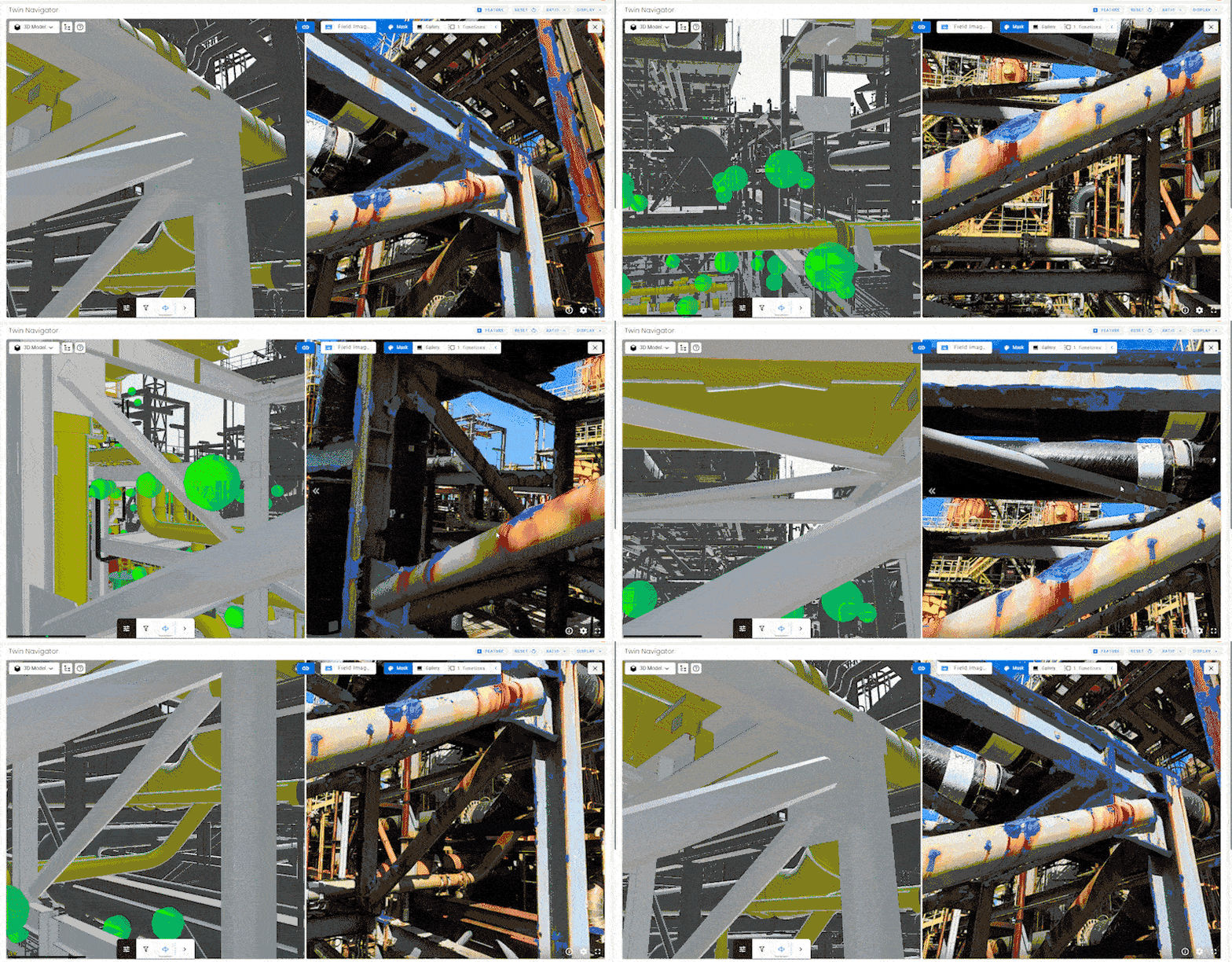
Bring the field back into the control environment. Navigate through inspection photos, anomaly records, and on-site evidence to the affected equipment inside the Digital Twin. Teams no longer rely on isolated reports or memory; visual confirmation of real conditions becomes part of the risk evaluation process.
Vidya's System platform twin navigator tool
Vidya's system platform 3D model

Complete Visibility of Safety-Critical Barriers

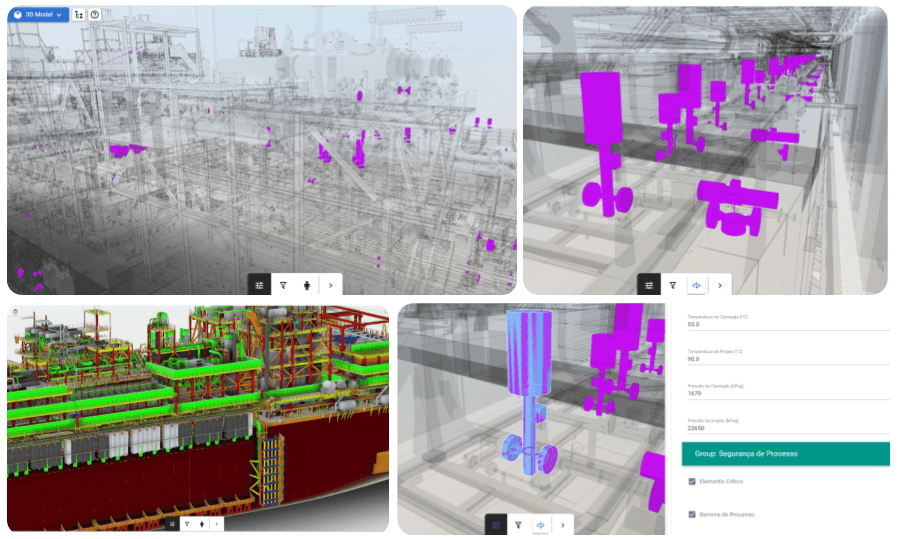
Access complete information for every safety-critical element in a single environment. Identify barriers, PSVs, and critical equipment within the 3D model and view their status, associated risk studies, inspection history, and linked engineering documentation. Risk exposure and barrier conditions can also be visualized through dynamic heatmaps, highlighting high-risk zones and critical clusters across the facility.

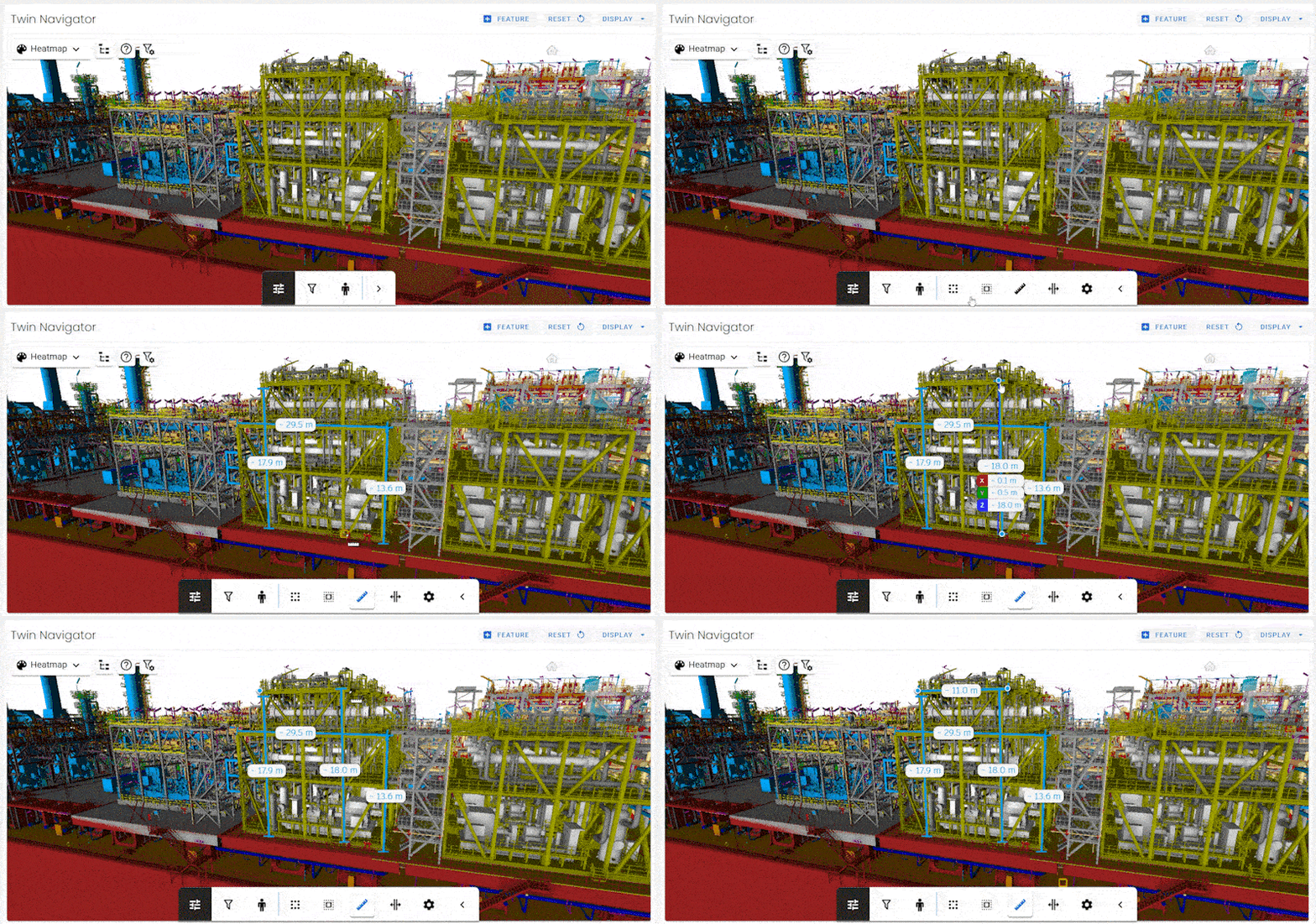
Virtual Outlining & Risk Analysis


Define affected areas and evaluate risk directly within the plant layout. Virtually outline equipment, systems, or process sections to assess exposure, understand escalation potential, and support structured decision-making. By analyzing impact spatially, teams can prioritize interventions, assess operational constraints, and determine mitigation strategies with greater precision and speed.
Vidya's System platform 3D model of a fpso

Built Around the Real Needs of Process Safety Professionals

See risk in context, not in documents

Be aware of everything that could go wrong. The Scenarios feature brings hazard and risk studies into the Digital Twin, showing what triggers an event, how it propagates through equipment and systems, which barriers are expected to respond, and what actions are required from each team. By animating consequences and procedures in context, it turns dispersed safety knowledge into clear operational guidance, helping teams anticipate escalation, verify safeguards, and execute the correct response with confidence.

Interface of a digital process safety platform showing a 3D industrial plant model with color-coded pipes and equipment. A highlighted valve appears in a zoomed view, while a side panel lists scenario events and a simulation table used for risk analysis and safety evaluation.

Field images for Situational Awareness

Bring the field back into the control environment. Navigate through inspection photos, anomaly records, and on-site evidence to the affected equipment inside the Digital Twin. Teams no longer rely on isolated reports or memory; visual confirmation of real conditions becomes part of the risk evaluation process.

Side-by-side comparison view showing a digital twin environment. The left panel displays 3D Model industrial structures and piping, while the right panel shows the field image of the same plant area with highlighted equipment and pipes for inspection and analysis.

Complete Visibility of Safety-Critical Barriers

Access complete information for every safety-critical element in a single environment. Identify barriers, PSVs, and critical equipment within the 3D model and view their status, associated risk studies, inspection history, and linked engineering documentation. Risk exposure and barrier conditions can also be visualized through dynamic heatmaps, highlighting high-risk zones and critical clusters across the facility.

Interface of a digital twin platform highlighting safety-critical barriers in an industrial facility. Multiple 3D views of a plant show equipment and valves highlighted in purple within the model. Accompanying text explains that the system provides complete visibility of safety-critical elements—such as PSVs and equipment—allowing users to access risk studies, inspection history, engineering documentation, and visualize risk exposure through heatmaps across the facility.

Virtual Outlining & Risk Analysis

Define affected areas and evaluate risk directly within the plant layout. Virtually outline equipment, systems, or process sections to assess exposure, understand escalation potential, and support structured decision-making. By analyzing impact spatially, teams can prioritize interventions, assess operational constraints, and determine mitigation strategies with greater precision and speed.

escribing a digital tool that allows users to define affected areas and evaluate risk directly within a plant’s 3D layout. The interface shows an industrial facility model where equipment and process sections are outlined with measurement markers to assess exposure, escalation potential, and support decision-making for prioritizing interventions and mitigation strategies.

Challenges you may be facing:

Safety-critical data is dispersed across multiple systems, documents, and teams, making it difficult to obtain a consistent and reliable view of hazards, safeguards, and their current status.

Operators, engineers, and HSE teams do not always have timely access to the risk context, historical studies, or barrier requirements needed for informed field decisions.

Safeguards may no longer reflect current operating conditions, production targets, or plant modifications, creating a false sense of protection.

Barrier availability, testing status, impairments, and performance are not tracked in a structured way, leading to decisions based on assumptions rather than evidence.

HAZOP, HAZID, and PRA results remain as standalone reports, disconnected from daily operations and from the physical assets they describe.

Process modifications are not consistently evaluated against existing hazards and safeguards, increasing the risk of unintended consequences.

Providing auditable evidence of barrier performance, inspection history, and risk assessments is time-consuming and often relies on manual document gathering.

Lessons learned from incidents and near-misses are not systematically linked to barriers, training, or asset context, limiting knowledge transfer across teams and units.

Challenges you may be facing:

Safety-critical data is dispersed across multiple systems, documents, and teams, making it difficult to obtain a consistent and reliable view of hazards, safeguards, and their current status.

Operators, engineers, and HSE teams do not always have timely access to the risk context, historical studies, or barrier requirements needed for informed field decisions.

Safeguards may no longer reflect current operating conditions, production targets, or plant modifications, creating a false sense of protection.

Barrier availability, testing status, impairments, and performance are not tracked in a structured way, leading to decisions based on assumptions rather than evidence.

HAZOP, HAZID, and PRA results remain as standalone reports, disconnected from daily operations and from the physical assets they describe.

Process modifications are not consistently evaluated against existing hazards and safeguards, increasing the risk of unintended consequences.

Providing auditable evidence of barrier performance, inspection history, and risk assessments is time-consuming and often relies on manual document gathering.

Lessons learned from incidents and near-misses are not systematically linked to barriers, training, or asset context, limiting knowledge transfer across teams and units.

Checklists, alerts, risk studies, repairs, and evidence.
All in the same environment

See how Digital Process Safety helps you convert a degraded safeguard into an end-to-end mitigation workflow
Vidya's DPS Workflow

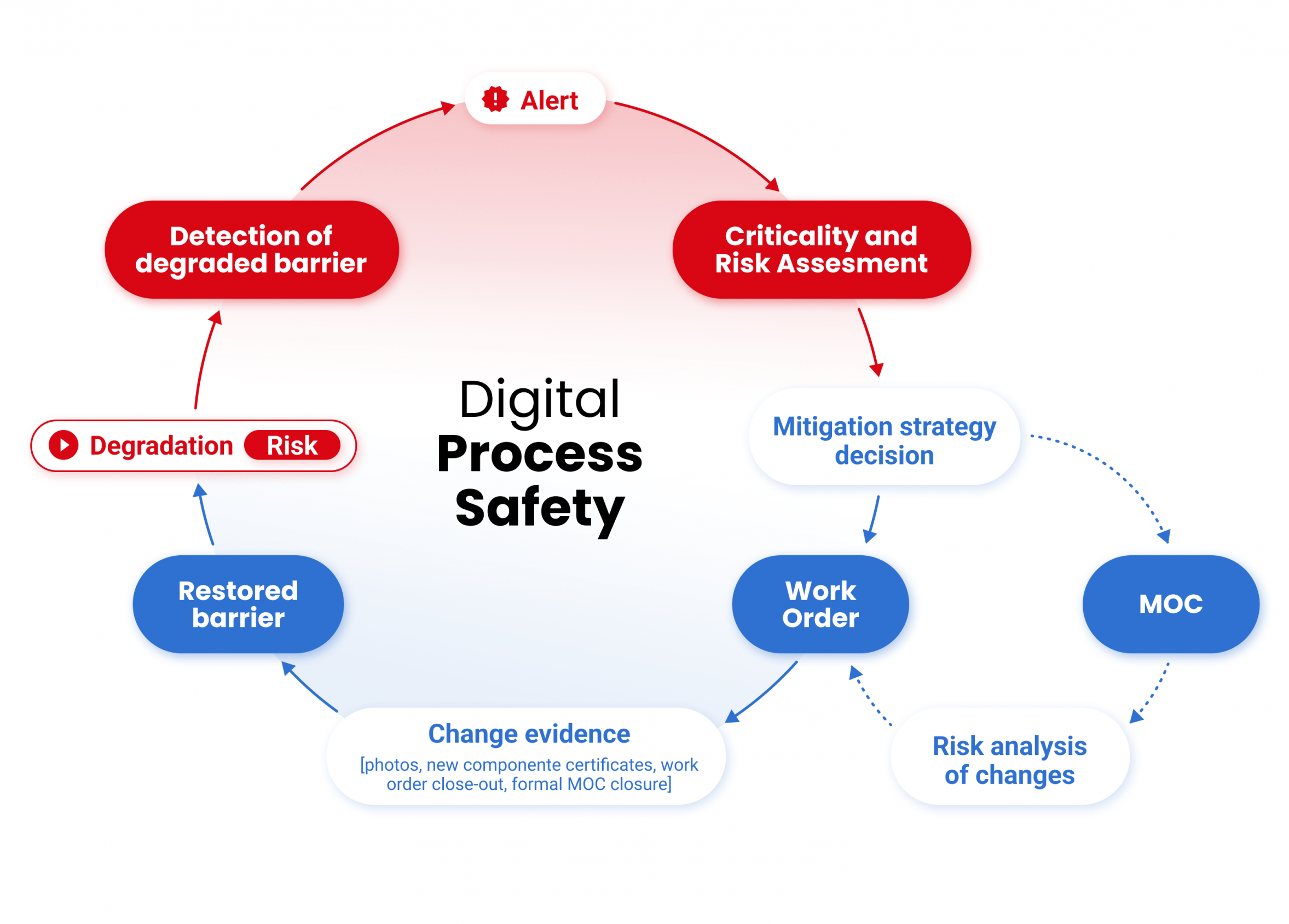
This application supports a cyclic management loop for process safety integrity. When a degraded barrier or anomaly is detected (whether through inspection findings or periodical operational alerts), the system enables structured criticality and risk assessment within the same environment. Required interventions can be initiated as work orders, linked directly to the affected asset and its associated risk scenario.

As maintenance activities are executed, evidence such as photographs, component certifications, inspection reports, and close-out records is uploaded and tied to the corresponding action. This ensures that restoration actions are documented, traceable, and auditable. Once the intervention is completed and verified, the barrier status is updated, closing the loop and integrating inspection, maintenance, and safety into a single workflow.
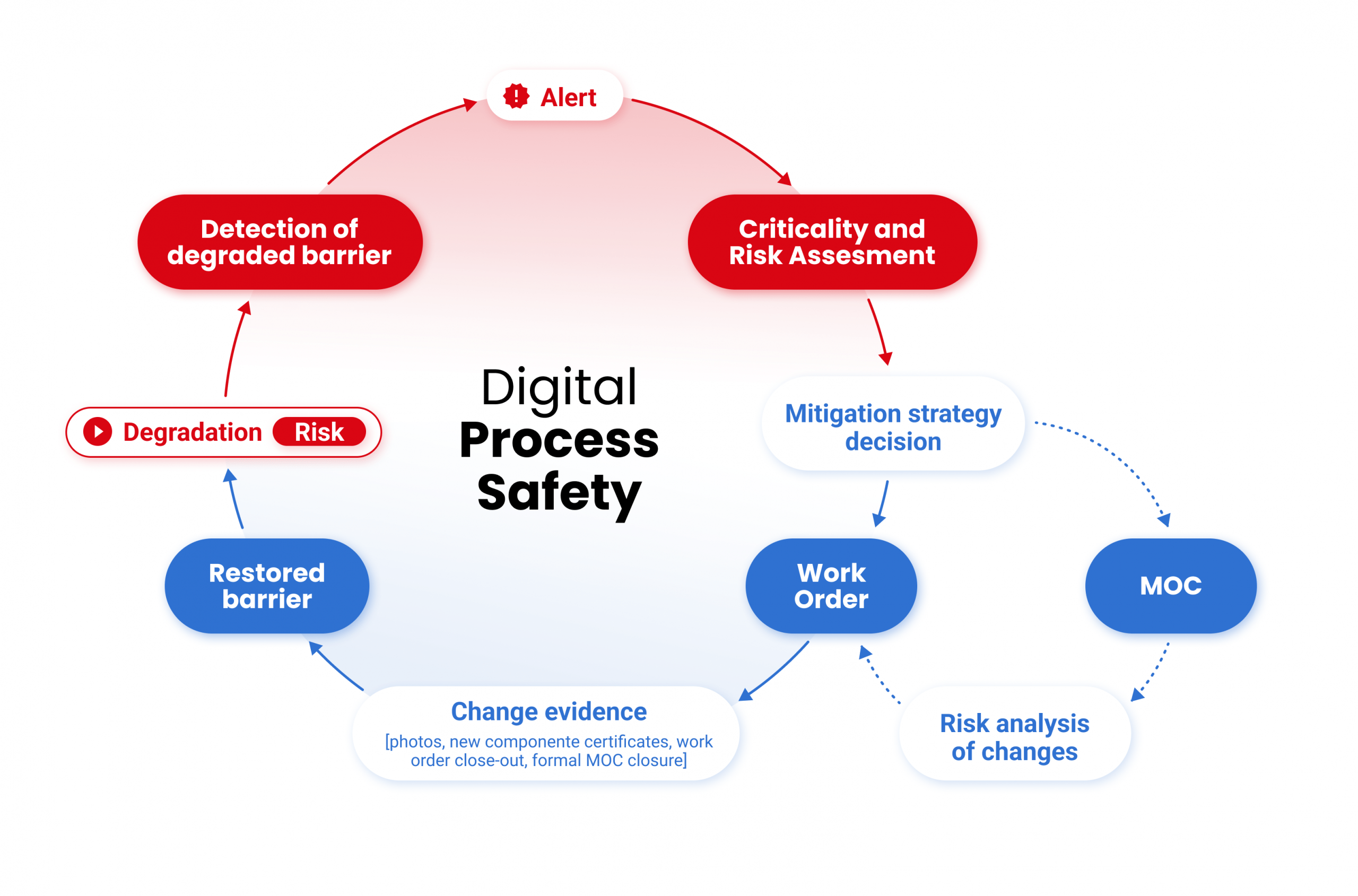
Circular workflow diagram titled “Digital Process Safety.” The cycle begins with detection of a degraded safety barrier, triggering an alert and leading to criticality and risk assessment. Based on the assessment, a mitigation strategy is defined, resulting in actions such as creating a work order or initiating a management of change (MOC). After risk analysis of changes and implementation, change evidence is recorded and the barrier is restored, completing the cycle and returning the system to normal operation.

Checklists, alerts, risk studies, repairs, and evidence.
All in the same environment

See how Digital Process Safety helps you convert a degraded safeguard into an end-to-end mitigation workflow

This application supports a cyclic management loop for process safety integrity. When a degraded barrier or anomaly is detected (whether through inspection findings or periodical operational alerts), the system enables structured criticality and risk assessment within the same environment. Required interventions can be initiated as work orders, linked directly to the affected asset and its associated risk scenario.

As maintenance activities are executed, evidence such as photographs, component certifications, inspection reports, and close-out records is uploaded and tied to the corresponding action. This ensures that restoration actions are documented, traceable, and auditable. Once the intervention is completed and verified, the barrier status is updated, closing the loop and integrating inspection, maintenance, and safety into a single workflow.

Digital Process Safety features

Digital Twin

Interface where users can view a contextualized 3D model with their data and access the system’s features, including viewing attributes, studies, documentation, components, viewing filters, and heatmaps.
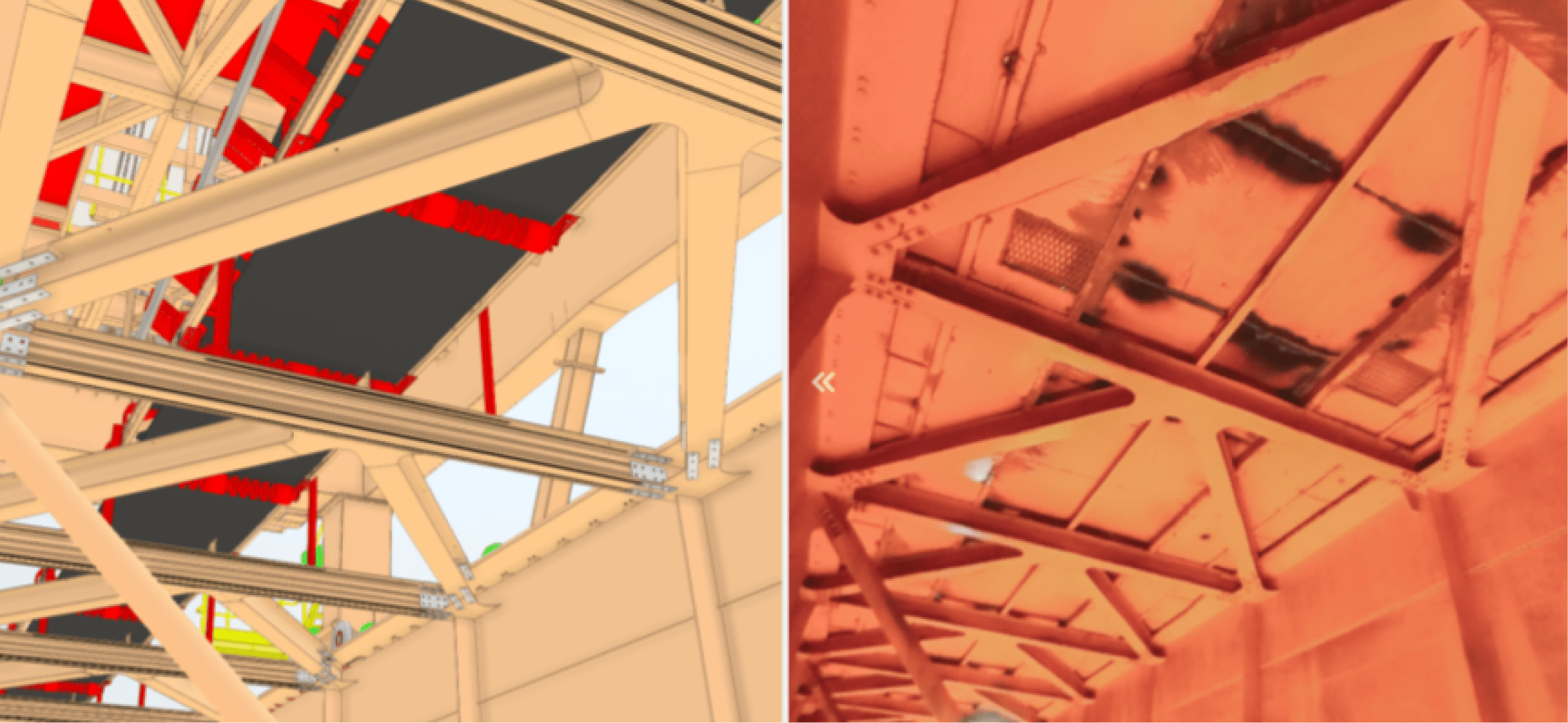
Based on the context provided in the image, here is an alt text description for the left side of the graphic: Alt Text: A side-by-side comparison showing a Digital Twin interface. On the left, a clean, high-fidelity 3D CAD model of an industrial truss and beam structure is displayed. On the right, a corresponding thermal heatmap or real-world scan of the same structure is shown in shades of orange and red, illustrating how data and studies are contextualized within the 3D model.

Heatmaps

Highlight concentrated risk zones based on the hazard risk matrix, so teams can visualize where interventions are more critical.
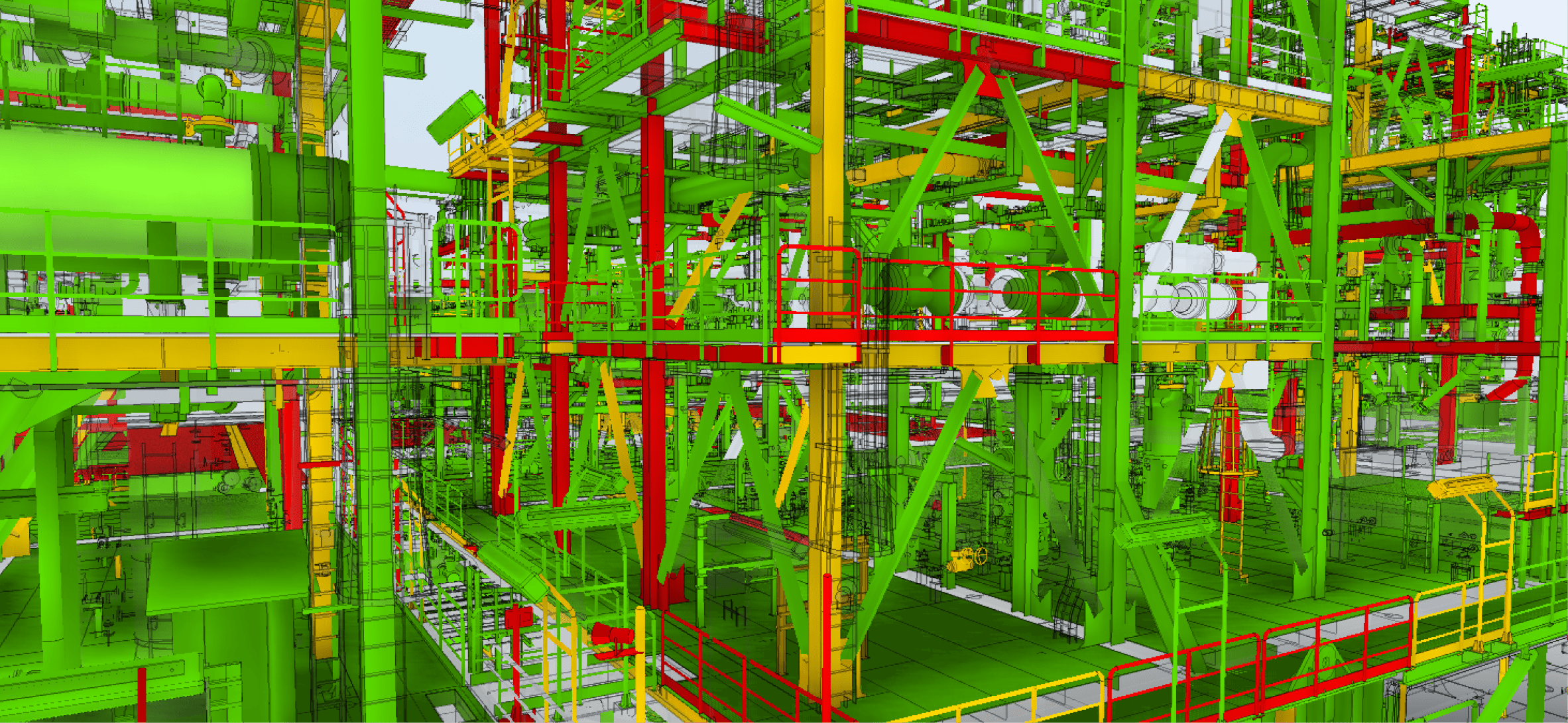
A complex 3D digital model of an industrial facility or refinery, functioning as a heatmap for risk management. The structural components, piping, and platforms are color-coded in green, yellow, and red based on a hazard risk matrix. The red sections highlight concentrated risk zones where interventions are most critical, while green indicates low-risk areas.

Mobile Application

Validate actions on site with guided workflows, predefined procedures with checklists and electronic forms, 3D facility visualization, photo evidence, user authentication and permissions, log recording, and full traceability.
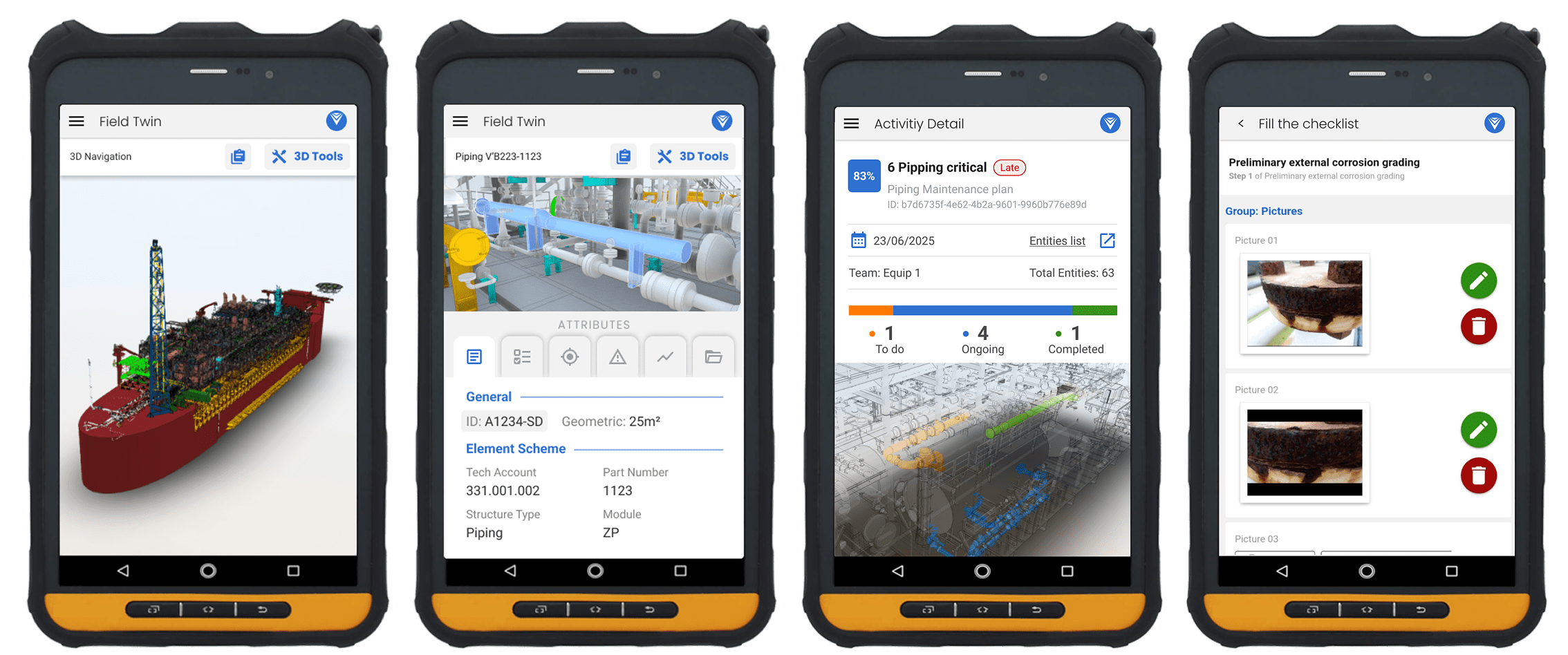
Four ruggedized mobile devices displaying different interface screens of a field application. The screens showcase the system's core capabilities: a 3D visualization of an offshore vessel, a detailed asset attribute view for piping, an activity dashboard with guided maintenance workflows and status bars, and a digital checklist for onsite validation featuring photo evidence and electronic forms.

Alerts

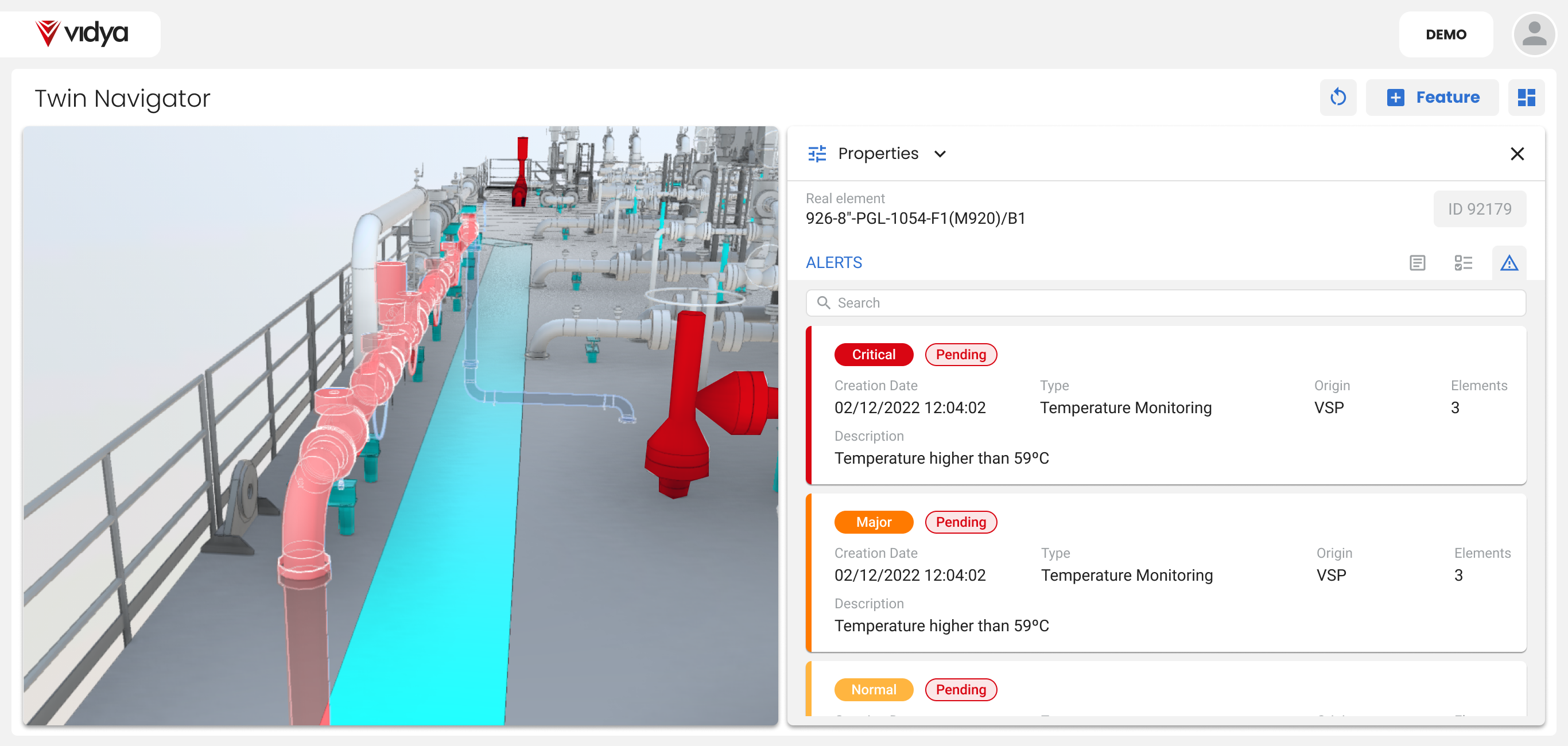
Stay ahead of overdue actions and incomplete information with automated notifications that protect risk visibility.

Scenarios

Visualize animations of initiating events, how risk propagates across connected assets, and the sequence of response actions required to contain it before operational impact occurs.
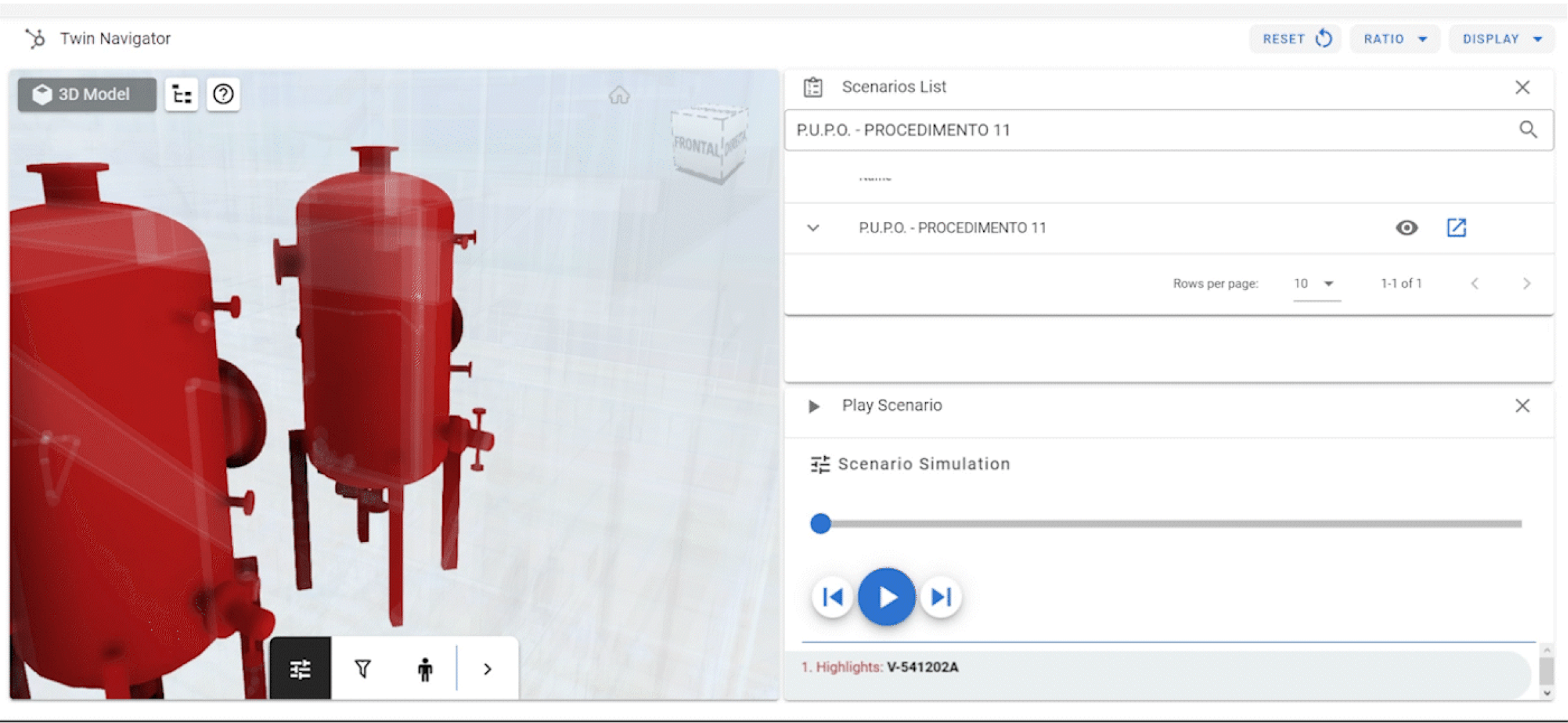
The "Twin Navigator" interface showcasing the Scenarios feature. To the left, a 3D model highlights industrial pressure vessels in red, representing an initiating risk event. To the right, a "Scenario Simulation" panel includes a playback timeline and controls, allowing users to visualize animations of risk propagation across assets and the sequence of response actions needed to contain the impact.

Digital Process Safety features

Vidya's System Platform 3D model comparison to reality

Digital Twin

Interface where users can view a contextualized 3D model with their data and access the system’s features, including viewing attributes, studies, documentation, components, viewing filters, and heatmaps.

Vidya's System Platform heatmap

Heatmaps

Highlight concentrated risk zones based on the hazard risk matrix, so teams can visualize where interventions are more critical.

Vidya's System platform mobile application

Mobile Application

Validate actions on site with guided workflows, predefined procedures with checklists and electronic forms, 3D facility visualization, photo evidence, user authentication and permissions, log recording, and full traceability.

The "Twin Navigator" interface showing an automated alert system for risk visibility. On the left, a 3D model of an industrial facility highlights a specific section of piping in red to signify a critical status. On the right, a detailed "Alerts" panel displays a list of pending notifications, including a critical temperature alert for 59°C. This demonstrates how the system provides visibility into overdue actions or incomplete information by linking data directly to the physical asset model.

Alerts

Stay ahead of overdue actions and incomplete information with automated notifications that protect risk visibility.

Vidya's System Platform Scenarios screen

Scenarios

Visualize animations of initiating events, how risk propagates across connected assets, and the sequence of response actions required to contain it before operational impact occurs.

Why you should Manage Process Safety with Vidya

  • Visualize hazard scenarios and their consequences in context

    View risk scenario simulations, affected areas, escalation paths, and barriers directly within the operational environment, allowing teams to understand potential impacts on people, assets, and production before making decisions.

  • Ensure traceability from hazard identification to field verification

    Follow each identified risk from initial registration through action planning, execution, and validation, ensuring that mitigations are implemented and confirmed in real conditions.

  • Reduce decision time with spatially contextualized safety data

    Access risk studies, barrier status, and deviations within the physical layout of the facility, eliminating the need to search across disconnected documents when evaluating operational conditions.

  • Track MOC impacts on process risk and affected assets

    Understand how approved changes influence hazard scenarios, safeguard performance, and risk levels by maintaining clear relationships between MOC records, studies, and field conditions.

  • Maintain audit-ready records of process safety analyses

    Keep structured, version-controlled histories of studies, assumptions, and approvals, enabling quick demonstration of compliance and reducing effort during internal and external audits.

  • Support consistent risk screening across multidisciplinary teams

    Apply standardized criteria for consequence, likelihood, and safeguard evaluation, ensuring that engineering, operations, and safety teams assess risk using the same methodology.

  • Highlight high-risk areas through configurable heatmaps

    Identify the concentration of risk based on configurable parameters such as consequence, exposure, barrier status, or operational criticality, or any other risk matrix, helping teams prioritize attention and resources.

  • Support safer interventions with instant access to safety-critical data

    Centralize studies, action plans, barrier data, and supporting documents in one environment, removing ambiguity about which information is current and approved.

Why you should Manage Process Safety with Vidya

  • Visualize hazard scenarios and their consequences in context

    View risk scenario simulations, affected areas, escalation paths, and barriers directly within the operational environment, allowing teams to understand potential impacts on people, assets, and production before making decisions.

  • Ensure traceability from hazard identification to field verification

    Follow each identified risk from initial registration through action planning, execution, and validation, ensuring that mitigations are implemented and confirmed in real conditions.

  • Reduce decision time with spatially contextualized safety data

    Access risk studies, barrier status, and deviations within the physical layout of the facility, eliminating the need to search across disconnected documents when evaluating operational conditions.

  • Track MOC impacts on process risk and affected assets

    Understand how approved changes influence hazard scenarios, safeguard performance, and risk levels by maintaining clear relationships between MOC records, studies, and field conditions.

  • Maintain audit-ready records of process safety analyses

    Keep structured, version-controlled histories of studies, assumptions, and approvals, enabling quick demonstration of compliance and reducing effort during internal and external audits.

  • Support consistent risk screening across multidisciplinary teams

    Apply standardized criteria for consequence, likelihood, and safeguard evaluation, ensuring that engineering, operations, and safety teams assess risk using the same methodology.

  • Highlight high-risk areas through configurable heatmaps

    Identify the concentration of risk based on configurable parameters such as consequence, exposure, barrier status, or operational criticality, or any other risk matrix, helping teams prioritize attention and resources.

  • Support safer interventions with instant access to safety-critical data

    Centralize studies, action plans, barrier data, and supporting documents in one environment, removing ambiguity about which information is current and approved.

See Digital Process Safety in action

Schedule a Demo & Experience the benefits. Contact us to learn how this solution fits your operation.

Beyond a digital solution, we help you to operate with ease. By scheduling a meeting, we will:

  • Understand your challenges: We’ll listen closely to your top concerns around process safety and the current methods you’re using

  • Showcase our Digital Process Safety application: Discover how our technology streamlines risk and process safety data management, saving you valuable time and resources.

  • Demonstrate real-world results: See firsthand the impact we’ve achieved for similar companies in reducing process safety issues.

  • Craft a tailored plan: We’ll work together to identify how our solution can specifically improve your risk management and monitoring processes.

  • Propose a pilot: Let’s target a specific area of your operation to address process safety challenges. Experience the results and scale up for total transformation.

Go to Top