Vidya Spatial Intelligence
Transforming Raw Field Data into Industrial Reality.
Traditional reality capture methods are often too costly and slow for dynamic industrial environments. Vidya’s Spatial Processing Unit (SPU) comes as a capability to transform these workflows through agile high-resolution imagery and video processing at enterprise volume.
As one of the few specialized deeptech in this matter, we are able to leverage 4D Spatial Computing to transform fragmented field captures into a cohesive industrial reality.
By establishing sophisticated relationships between pixels and 3D space, and employing Artificial Intelligence for scene understanding, the SPU functions as a robust and versatile engine designed for mass reality processing at scale. Our core premise is to generate data in context, turning voluminous visual input into a digital ecosystem where every pixel reflects the true state of the asset.
The World’s Largest Contextualized
Industrial Reality Reconstruction Database
Industrial Reality Reconstruction Database
+1.9 Million Field data contextualized
Proven Reality Reconstruction Across Critical Assets:
Offshore & Subsea Environments
- FPSOs (Floating Production Storage and Offloading)
Subsea Pipelines & Manifolds
BOPs (Blowout Preventers)
Subsea Christmas Trees
Onshore & Refining Operations
Refineries & Processing Plants
Wellheads
Flares
Shiploaders
Vessel Hulls
Conveyor Belts
Stack Reclaimers
Renewable Energy Sites
BOPs (Blowout Preventers)
Solar Farms
Eolic (Wind) Turbines
Spatial Data Processing Capabilities

Asset StreetView
Like an industrial street view of your assets, this capability enables massive-scale asset indexing by automatically synchronizing 360° and drone captures onto a 3D representation of each asset.
Automatic Scan Points: Effortlessly synchronize field imagery to the 3D model automatically
Remote Asset Exploration: Supports virtual delineations, immersive tours, remote training, and rapid asset familiarization.
Proven Efficiency: Achieve +90% coverage for industrial facilities
Rapid Deployment: Complete reality capture in 3 days for oil rigs, 6 days for refineries, 10 days for FPSOs, or 1 day for mining equipment.
Blind-Spot Mapping
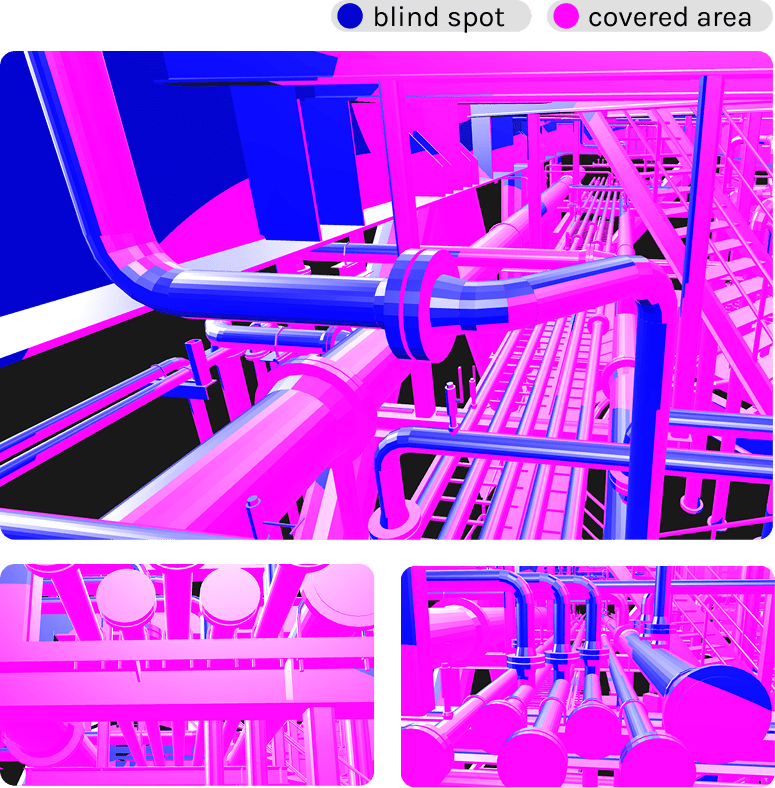
Vidya leverages advanced spatial computing to identify areas that are impossible to inspect by design, or that were not covered by previous 360 photos/drone reality capture campaigns, ensuring 100% auditable coverage.
Gap Identification: Accurately maps both campaign-specific misses and regions that are blind due to the asset characteristic itself
Coverage Efficiency: Determines the exact percentage of the structure successfully captured by images.
Field Guidance: Generates indications in the system to guide teams toward targeted blind spots field inspections.
Unparalleled Visibility: Eliminates dark zones to prevent hidden structural failures.
As-Built vs. As-Designed
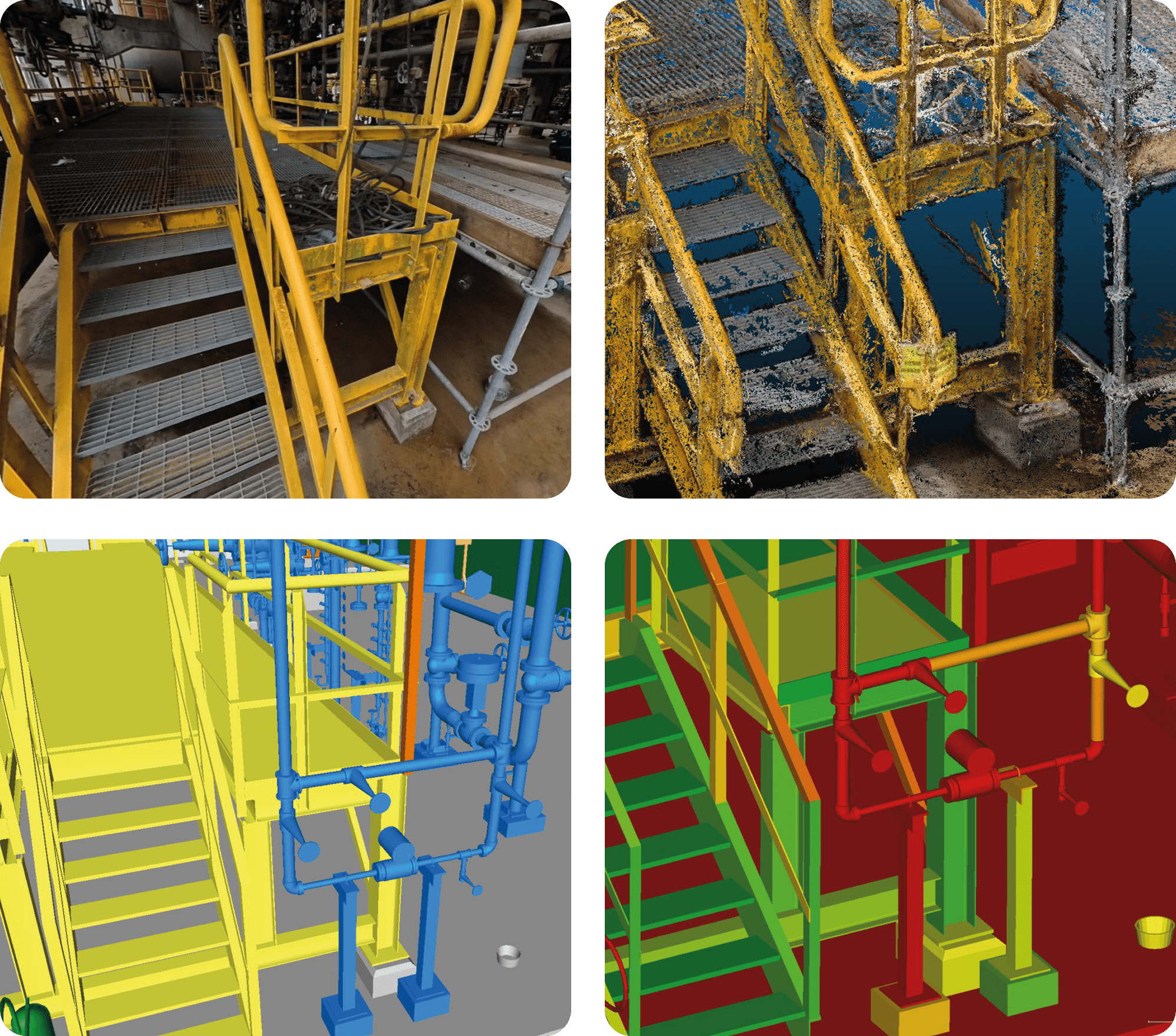
This unit identifies geometric inconsistencies between planned engineering models and the actual “as-is” field condition.
Scan vs. BIM Workflow: Prioritizes imagery over costly LiDAR to make reality capture faster and less intrusive.
Continuous Reality match: Eliminates “analysis lag” by keeping the digital model consistently validated against reality.
Resource Optimization: Reserves high-precision laser scanning only for areas requiring millimetric accuracy scanning data.
Deployment Reliability: Identifies configuration mismatches or missing components before they impact operational planning.
AI Anomaly Sweeper
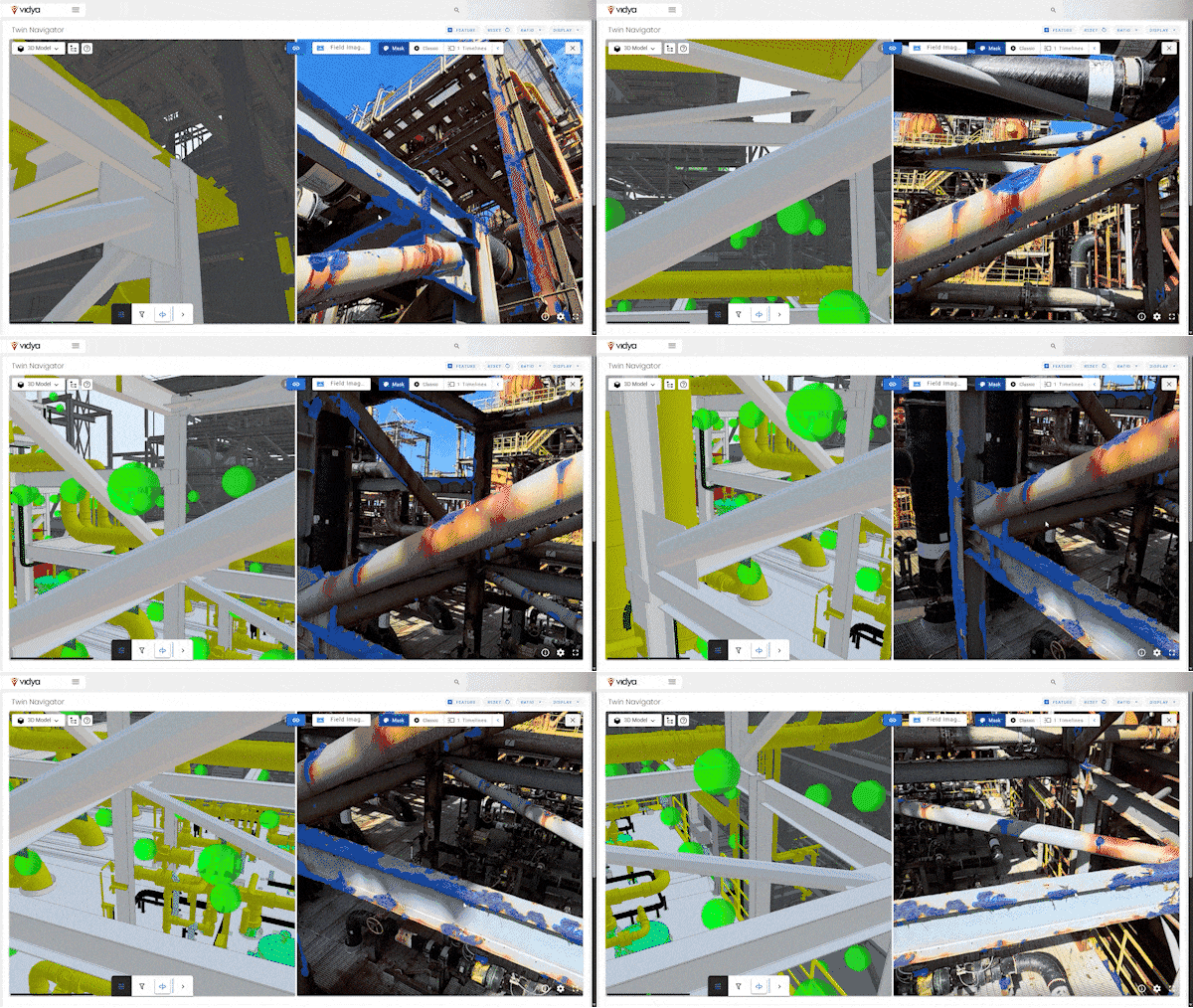
A high-capacity computer vision engine designed to process thousands of images and video frames for automated anomaly identification.
Specialized Models: Trained to detect a wide range of industrial anomalies such as coating failures, corrosion, pitting, cracks, structural deviations, ore accumulation, dirt, and DROPS risks.
Integrity Tracking: Directly links findings to the VSP for accurate monitoring and precise mitigation.
Temporal Analysis: Provides a historical record of degradation to predict, prioritize, and identify higher risk areas.
Subsea Spatial Processing (ROV)
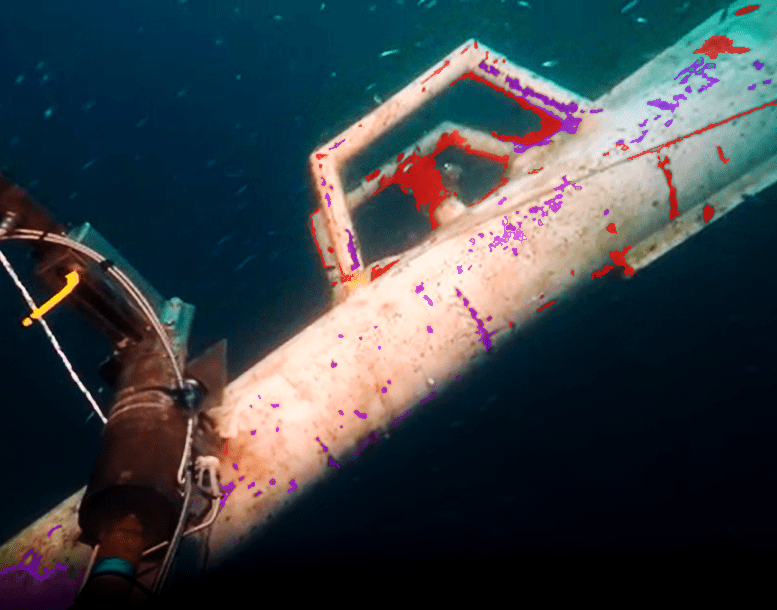
Vidya brings 4D spatial computing to the seabed, transforming fragmented underwater footage into a structured, navigable layout.
ROV Contextualization: Transforms raw video feeds into a spatial data stream within the subsea 3D layout.
Minute-to-Image Linkage: Anchors inspection findings to the exact timestamp of the original operation video.
Enhanced Navigation: Allows engineers to navigate through the subsea asset using high-resolution imagery as a spatial reference.
Ora Viewer:
Industrial Reality Reconstruction
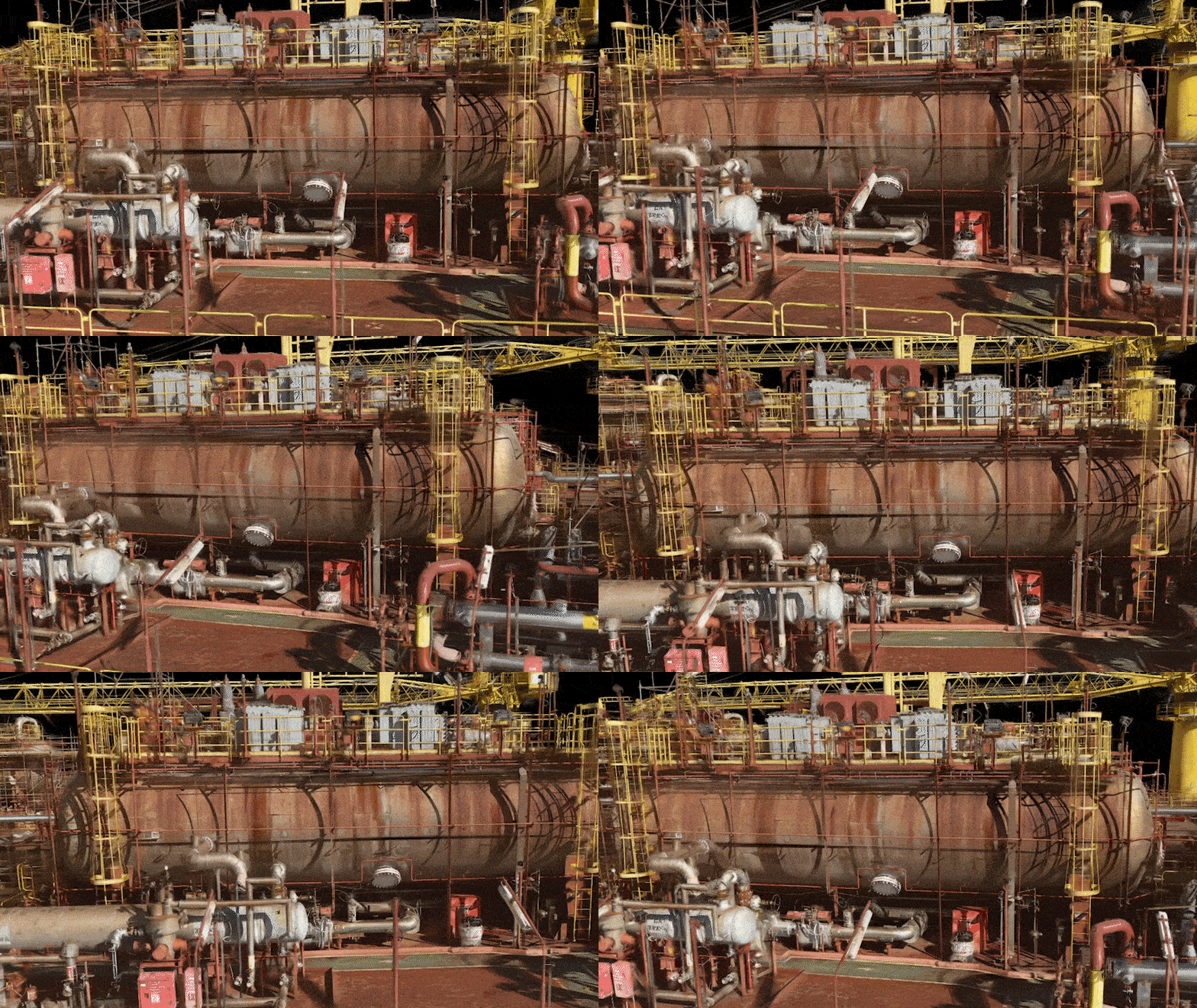
The first industrial viewer to move beyond point clouds, the Ora Viewer utilizes image-based Gaussian Splatting and NeRF technology to recreate heavy assets with absolute visual fidelity.
Immersive environment: Conduct virtual walk-throughs with clarity on textures, colors, and fine details as if standing physically on-site.
Next-Gen Reconstruction: Leverages pioneering technology to handle complex industrial structures without the lag or “hollowness” of traditional point clouds.
Enhanced Visual Context: Provides engineers with the granular detail needed to identify subtle degradation and plan high-precision interventions.
Spatial Processing Capabilities
Asset StreetView
Like an industrial street view of your assets, this capability enables massive-scale asset indexing by automatically synchronizing 360° and drone captures onto a 3D representation of each asset.
Automatic Scan Points: Effortlessly synchronize field imagery to the 3D model automatically
Remote Asset Exploration: Supports virtual delineations, immersive tours, remote training, and rapid asset familiarization.
Proven Efficiency: Achieve +90% coverage for industrial facilities
Rapid Deployment: Complete reality capture in 3 days for oil rigs, 6 days for refineries, 10 days for FPSOs, or 1 day for mining equipment.
Blind-Spot Mapping
Vidya leverages advanced spatial computing to identify areas that are impossible to inspect by design, or that were not covered by previous 360 photos/drone reality capture campaigns, ensuring 100% auditable coverage.
Gap Identification: Accurately maps both campaign-specific misses and regions that are blind due to the asset characteristic itself
Coverage Efficiency: Determines the exact percentage of the structure successfully captured by images.
Field Guidance: Generates indications in the system to guide teams toward targeted blind spots field inspections.
Unparalleled Visibility: Eliminates dark zones to prevent hidden structural failures.
As-Built vs. As-Designed
This unit identifies geometric inconsistencies between planned engineering models and the actual “as-is” field condition.
Scan vs. BIM Workflow: Prioritizes imagery over costly LiDAR to make reality capture faster and less intrusive.
Continuous Reality match: Eliminates “analysis lag” by keeping the digital model consistently validated against reality.
Resource Optimization: Reserves high-precision laser scanning only for areas requiring millimetric accuracy scanning data.
Deployment Reliability: Identifies configuration mismatches or missing components before they impact operational planning.
AI Anomaly Sweeper
A high-capacity computer vision engine designed to process thousands of images and video frames for automated anomaly identification.
Specialized Models: Trained to detect a wide range of industrial anomalies such as coating failures, corrosion, pitting, cracks, structural deviations, ore accumulation, dirt, and DROPS risks.
Integrity Tracking: Directly links findings to the VSP for accurate monitoring and precise mitigation.
Temporal Analysis: Provides a historical record of degradation to predict, prioritize, and identify higher risk areas.
Subsea Spatial Processing (ROV)
Vidya brings 4D spatial computing to the seabed, transforming fragmented underwater footage into a structured, navigable layout.
ROV Contextualization: Transforms raw video feeds into a spatial data stream within the subsea 3D layout.
Minute-to-Image Linkage: Anchors inspection findings to the exact timestamp of the original operation video.
Enhanced Navigation: Allows engineers to navigate through the subsea asset using high-resolution imagery as a spatial reference.
Ora Viewer:
Industrial Reality Reconstruction
The first industrial viewer to move beyond point clouds, the Ora Viewer utilizes image-based Gaussian Splatting and NeRF technology to recreate heavy assets with absolute visual fidelity.
Immersive environment: Conduct virtual walk-throughs with clarity on textures, colors, and fine details as if standing physically on-site.
Next-Gen Reconstruction: Leverages pioneering technology to handle complex industrial structures without the lag or “hollowness” of traditional point clouds.
Enhanced Visual Context: Provides engineers with the granular detail needed to identify subtle degradation and plan high-precision interventions.
Reality data in place, Reality data with Context
Vidya’s technology is built on the foundation of Mass Reality Processing. It means it can process massive, heavy volumes of visual data to generate actionable insights within their exact spatial context.
Agile & Differentiated Capture
Vidya doesn’t require the logistical burden of traditional methods, specializing in the rapid processing of high-resolution images and videos.
4D Spatial Computing
The technology goes beyond 3D by establishing a dynamic link between visual data and physical coordinates over time, allowing for a deep understanding of asset evolution.
Robust & Versatile Engine
Designed for the most demanding industrial environments, from offshore platforms to subsea layouts, our expertise handles the heavy lifting of data alignment and reconstruction at scale.
Why a traditional reality capture technique is no Longer Enough
Most reality platforms or techniques are reduced to 3D maps. They show you where an asset is, but they don’t tell you how it feels. In corrosive offshore or subsea environments, a “wait and see” approach leads to failure. The Spatial Intelligence shifts your strategy from Visual Representation to Enhanced Intelligence.
Frequently Asked Questions [FAQ]
360° cameras are significantly faster to deploy and more cost-effective. For visual anomalies like corrosion or pitting, high-resolution imagery provides the necessary color and texture data that AI models need to identify anomalies.
It allows for rapid identification of major field divergencies. By using imagery first, you can pinpoint exactly where the asset has changed and then strategically deploy high-precision laser scanning only for areas that require millimetric modeling, optimizing both time and budget.
The frequency depends on your specific operational goals. For general integrity monitoring, annual campaigns are common, while high-activity areas may require “mission-specific” captures following major maintenance or structural modifications.
Our system is highly adaptable. We can train and specialize a custom computer vision model tailored to identify specific defects or conditions unique to your asset.
While we do not produce traditional CAD 3D models from images, we use pioneering Gaussian Splatting to create ultra-photorealistic 3D representations. These provide a higher level of photographic detail than standard point clouds or CAD models.
Yes. We have specialized teams ready for deployment. Alternatively, we provide technical specifications that allow your own teams to capture the data, which can then be sent to us for processing.
We focus on the “intelligence layer” of spatial processing. We do not own hardware; instead, we work with a network of specialized partners to provide the best capture technology for each specific environment.
We are always looking to expand our ecosystem. If you provide high-quality reality capture services, please contact us through our partner portal to discuss how we can integrate your capture capabilities with our processing unit.
Think of the SPU as the engine that “populates” the Digital Twin. These processes provide the visual reality, spatial context, and automated intelligence that transform a static 3D model into a dynamic, condition-aware Digital Twin.
Experience the Future of Spatial Intelligence Schedule a Demo to learn more & See the Tech in Action.
By scheduling a meeting, we will:
- Understand your challenges: We’ll listen closely to your top concerns around reality capture and the current methods you’re using
Showcase our Spatial Processing Capabilities: Discover how our technology reconstructs reality and allows precise diagnoses.
Demonstrate real-world results: See firsthand the impact we’ve achieved for similar companies in recustructing reality.
Craft a tailored plan: We’ll work together to identify how our solution can specifically improve your asset awareness.
Propose a pilot: Let’s target a specific area of your operation to address spatial challenges. Experience the results and scale up for total transformation.