
Throughout the first half of 2026, the Vidya System Platform received a series of updates to make operations easier to understand, plan, decide, and act on. The release expands capabilities across existing applications, such as Vidya’s main product, the Digital Fabric Integrity (DFI), while introducing new solutions such as Digital Reality Match (DRM), alongside enhanced visualization tools and usability improvements. Many of these advances are the result of years of industrial deployments, continuously refining both the platform and the engineering workflows it supports.
Here’s a closer look at the platform enhancements introduced during the first half of 2026.
Major update: Digital Fabric Integrity 2.0
Authority isn’t built overnight. Since 2018, DFI has evolved continuously alongside real industrial operations. With some units now reaching their fifth consecutive annual campaigns, DFI 2.0 transforms nearly a decade of operational maturity into the industry’s most complete tool for spatial understanding of asset conditions.
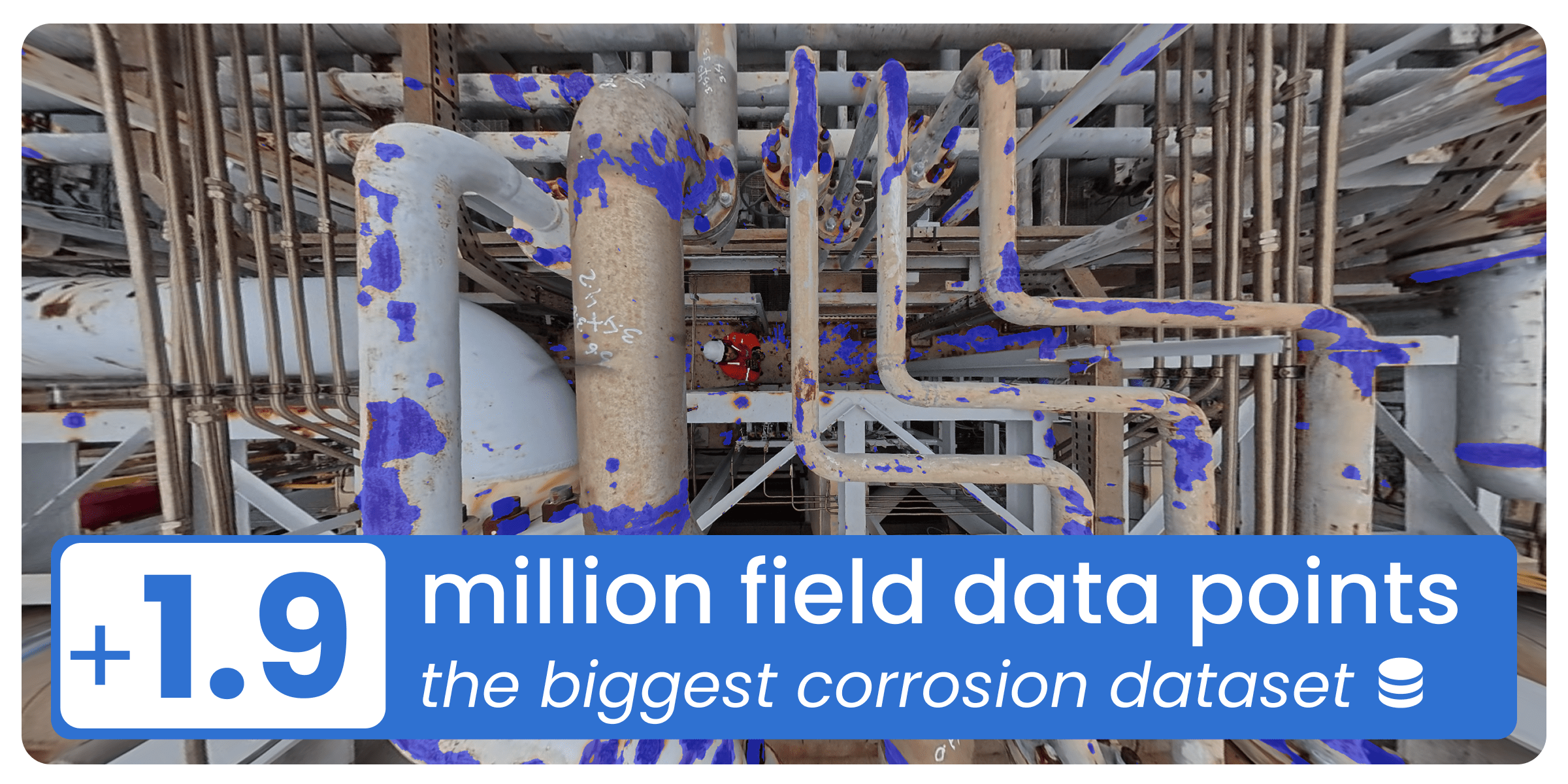
This new generation expands this capability through metre-by-metre reality navigation, AI models trained on more than 1.9 million field data points, and blind spot mapping for improved coverage visibility.
- Trained Through Operational Reality: With over 1.9 million field data points processed across industrial operations, DFI’s Computer Vision models continue to evolve in accuracy, speed, and anomaly interpretation.
- High-Fidelity Asset Navigation: Reality capture campaigns now provide a high-density Street View navigation (metre-by-metre scan points), maximizing the perspectives available to understand the facility’s integrity conditions.
Align 3D models with Field Reality: Digital Reality Match
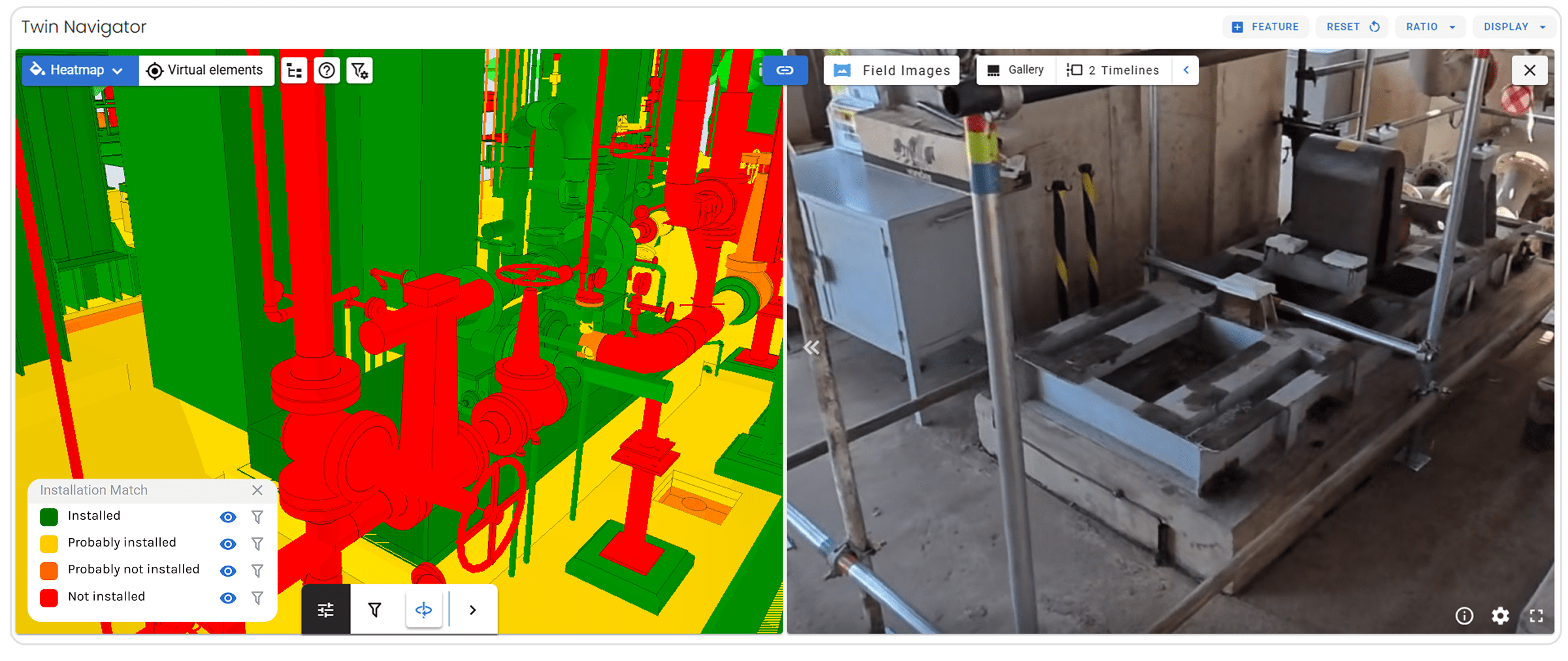
Vidya’s Digital Reality Match application automates Scan vs. BIM workflows by comparing field reality with engineering design information to identify, classify, and contextualize deviations between as-built and as-designed conditions.
Using reality capture data, the application creates a spatially indexed representation of the facility, automatically matching observed conditions with corresponding elements in the 3D model. This enables teams to validate asset configuration, identify divergences, and maintain an accurate digital representation of the physical environment.
The application supports asset management, project validation, and execution by providing a reliable connection between field conditions and digital documentation. Custom filters, element lists, and 3D heatmaps allow users to navigate divergences, prioritize actions, and improve visibility across complex industrial environments through optimal material procurement. With this application, operations can:
- Map field divergences autonomously
- Track project or construction progress
- Spatially index images to their corresponding element in the 3D model
- Reduce rework due to inconsistencies between field data and 3D models
- Lower risk exposure with fewer site visits
- Reach 95% accuracy in identifying field discrepancies
- Reduce uncertainty in material procurement planning
New Vidya System Platform [VSP] capabilities
Alongside DFI 2.0 and Digital Reality Match, the Vidya System Platform introduces new capabilities that improve visualization, integrity tracking, and operational efficiency.
4D anomaly management: Virtual Elements
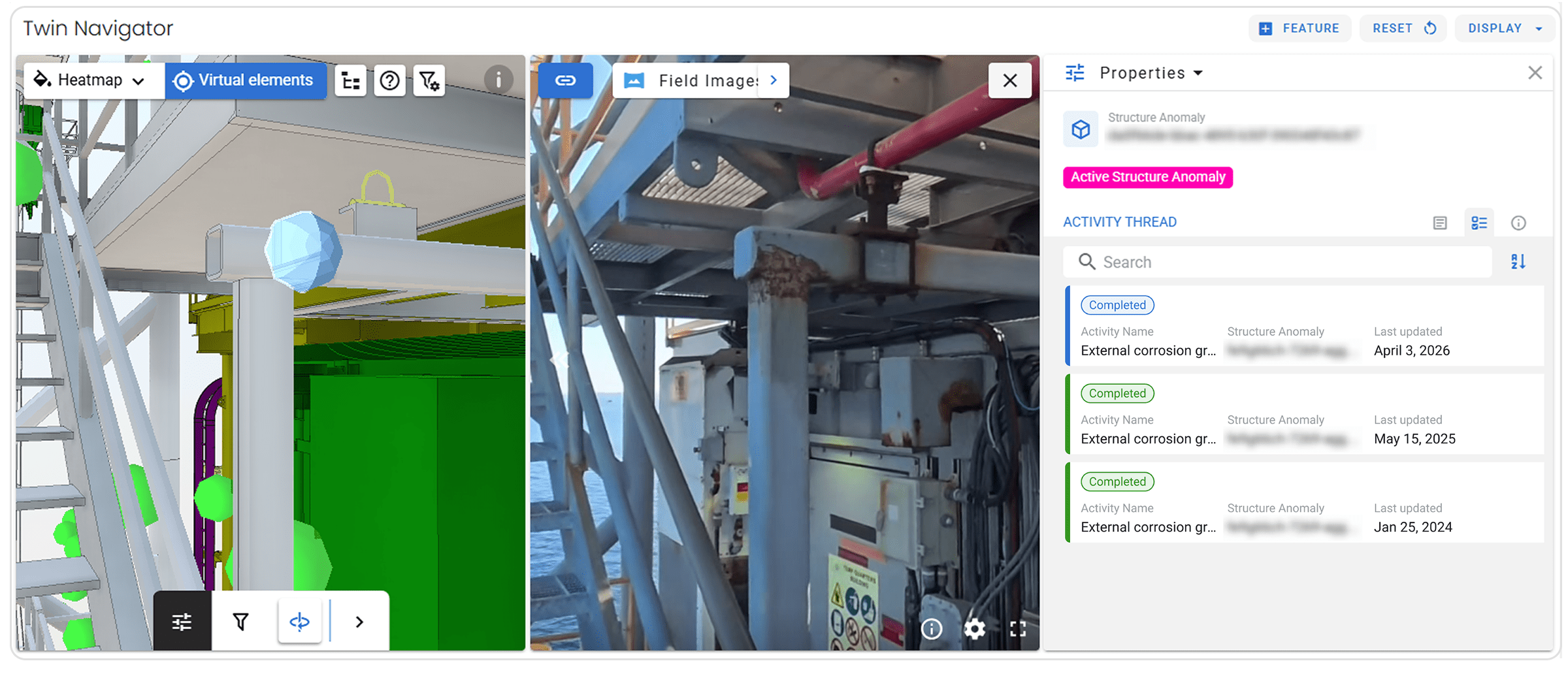
A single structural element may accumulate multiple anomalies over successive inspection campaigns, each with its own location, condition, and evolution over time. To better represent these scenarios, the Vidya System Platform now introduces Virtual Elements, allowing users to create independent indications for individual anomalies on the 3D model. Each virtual element maintains its own spatial position, attributes, and inspection history, enabling more accurate temporal tracking and a clearer understanding of degradation progression. This new capability allows:
- Anomaly indication beyond element geometry, allowing findings to be positioned precisely where they occur rather than being constrained by the underlying 3D model.
- Native support for Corrosion Monitoring Locations (CMLs) and Technical Inspection Recommendations (TIRs), bringing critical integrity information directly into the spatial context of the asset.
- Pinpointing, enabling users to indicate, organize, and manage anomalies with precise X, Y, Z positioning and supporting images. By referencing anomalies directly into the digital environment, Virtual Elements provides richer context for inspections, planning activities, and team collaboration.
- Mobile availability extends these capabilities to field teams for easier access to integrity information during inspections and site activities.
Unlocking web operation for the largest assets: Field-persistent filter
Digital twins of large industrial facilities often contain thousands of equipment and inspection records, making it difficult to maintain focus on the information relevant to a specific activity. When you’re working on a specific module, you don’t need to load the entire asset; you can boost 3D processing performance with this feature. With Persistent Filter, you can define a scope once and keep it active across sessions. Whether you refresh the platform, close your browser, or log in again later, your selected context remains available.
With this focused rendering capability, the platform displays only the assets, disciplines, or integrity information required for the task at hand. The result is a cleaner visualization, improved rendering performance, and a more efficient workflow when working across complex industrial facilities.
Blind Spot Mapping for Full Visibility
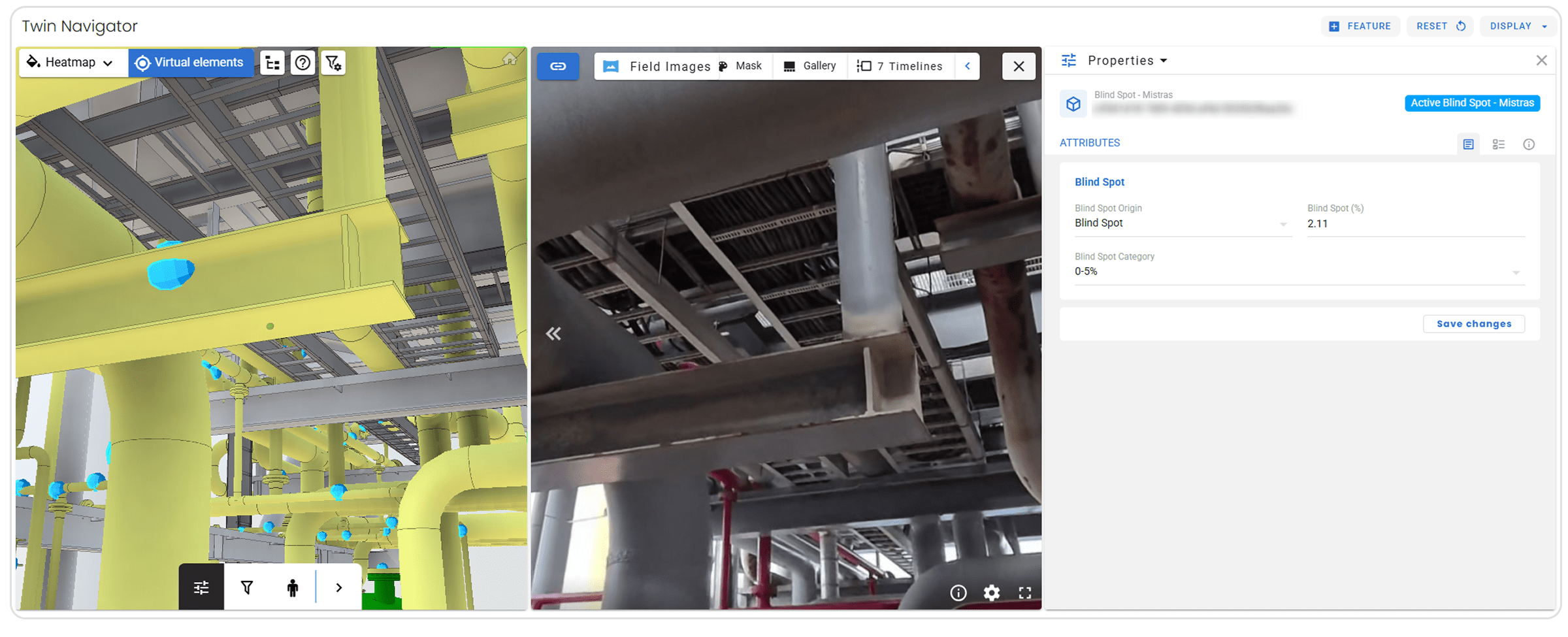
Reality capture campaigns are only as valuable as their coverage. When portions of a facility are not captured during image acquisition, those blind spots can go unnoticed, creating uncertainty around inspection completeness and potentially leaving critical areas undocumented.
Blind Spot Visibility automatically identifies and maps areas with insufficient reality capture coverage, providing a clear view of where image acquisition may need to be supplemented. By visualizing coverage gaps directly within the digital environment, engineering teams can validate campaign completeness, improve inspection planning, and increase confidence that asset assessments are based on comprehensive field data.
Core Usability Enhancements
Beyond new product capabilities, this release also introduces improvements focused on platform security and day-to-day execution workflows.
Enhanced Security with Multi-Factor Authentication (MFA)
To strengthen platform security and support enterprise cybersecurity requirements, the Vidya System Platform now includes Multi-Factor Authentication (MFA). By requiring an additional verification step during authentication, MFA provides an extra layer of protection against unauthorized access while aligning with industry security best practices.
A More Efficient Workpack Experience
Workpack management has been refined to simplify planning and execution activities. The updated interface improves navigation and usability, while new activity grouping capabilities allow users to organize, manipulate, and manage multiple activities more efficiently. These enhancements streamline workpack preparation and reduce the effort required to coordinate inspection and maintenance tasks across large-scale projects.
Looking Ahead: System Refinement Roadmap
The next phase of development focuses on strengthening how operations teams plan, execute, and monitor assets throughout the operational cycle. Building on the platform’s PDCA-driven approach, upcoming capabilities are designed to provide greater visibility into ongoing work while making activity management more flexible across disciplines.
Kanban-Based Activity Management
A new Kanban Board is currently under development to provide a visual approach to managing engineering activities. By organizing work according to its execution status, teams will be able to monitor progress more intuitively, identify bottlenecks, and improve coordination across inspection, maintenance, and integrity workflows.
Cross-Discipline Workpack Management
Future releases will also introduce the ability to migrate activities between workpacks across disciplines, providing greater flexibility as project priorities evolve. This capability will simplify workpack adjustments, improve resource coordination, and support more efficient execution of multidisciplinary integrity programs.
Accurate As-Built References for Engineering Fabrication
Engineering modifications depend on having accurate measurements of existing equipment. Yet fabrication and retrofit projects often rely on outdated documentation or time-consuming, risk-prone field verification to obtain critical dimensions.
This upcoming capability extends the Digital Twin with laser scanning and high-density point cloud data, creating highly accurate as-built representations of industrial equipment. By integrating fabrication workflows with laser scanning and cloud point modelling, teams can validate dimensions, understand existing conditions, and support engineering decisions with greater confidence before work begins.
Beyond fabrication, the capability also supports retrofit, maintenance, life extension, repurposing, and reverse engineering initiatives by providing a precise digital foundation for planning and execution.
Continuous User Experience Refinement
Alongside major platform capabilities, development continues to focus on the countless interactions that shape everyday use of the Vidya System Platform. Small improvements to navigation, information access, and workflow execution are continuously incorporated to reduce friction and make routine engineering tasks more intuitive.
By refining these day-to-day experiences alongside larger product initiatives, the platform continues to evolve through a smoother, more efficient user experience across engineering, inspection, and integrity workflows.
About the Author: Jorge Kawano