
Securing the integrity of large-process facilities requires meticulous coordination of multiple teams and data sources. Equipment degrades, new inspection data becomes available, risks evolve, and interventions need to be continuously reassessed. At the scale of refineries, FPSOs, power plants, and other complex industrial facilities, this becomes increasingly difficult to manage. These assets can span hundreds of thousands of square meters and contain thousands of pieces of equipment and components. In this manner, maintaining a consistent view of asset condition, ensuring that relevant information reaches the right teams, and translating findings into timely interventions becomes a continuous challenge.
The Information Challenge in Integrity Management
A significant part of the complexity lies in the information required to understand and manage asset integrity. Rasys, E. et al. (2014) stated that core engineering information, such as process diagrams, technical datasheets, and user manuals, remains fragmented and heterogeneous in the form of 2D documents and 3D drawings. Over time, these sources are joined by inspection findings, operational records, maintenance histories, field evidence, and other datasets produced across the asset lifecycle. However, simply bringing this information together is only the first step; it must be connected to the asset, its condition, its associated risks, and the interventions required to manage them.
More Findings Require Clearer Priorities
As inspection coverage expands and analytical technologies become more capable, organizations can identify anomalies at a scale that would be difficult to manage through manual review alone. The challenge therefore shifts from finding anomalies to determining which findings require attention, how they should be prioritized, and what action they should trigger.
For large industrial assets, where thousands of findings may be generated across different areas, equipment, and inspection campaigns, treating every finding with the same level of attention is neither practical nor consistent with risk-based integrity management. Findings need to be interpreted within the context of the asset and evaluated against defined business rules, risk criteria, and operational priorities.
Without this prioritization layer, increasing the amount of available inspection information can increase the workload without necessarily improving decision-making. The objective is therefore not simply to detect more, but to consistently distinguish what matters, establish what requires action, and provide a clear basis for the next stage of integrity management.
Integrity does not end with identification
Identifying an anomaly is only one step in the integrity-management process. The real challenge is translating that finding into a decision and, ultimately, into an action that changes the condition of the asset. On large and complex facilities, this requires findings to be evaluated in their operational context, prioritized according to risk, and connected to the resources and interventions required to address them.
As asset conditions and priorities change, these decisions cannot be treated as isolated events. New inspection findings can alter existing priorities, diagnostic information can change the recommended intervention, and field activities can generate new evidence about the asset. Maintaining integrity therefore requires a continuous flow between assessment, prioritization, planning, and execution rather than a process that ends once an anomaly has been identified.
This also creates a coordination challenge. The teams responsible for analyzing asset condition, defining priorities, planning interventions, allocating resources, and executing field activities may operate at different stages of the process. If the information and decisions generated at one stage do not effectively feed the next, the connection between identifying a risk and actually managing it can weaken.
For integrity management at scale, therefore, the objective is to establish a continuous management cycle in which information informs decisions, decisions drive interventions, and the results of those interventions feed the next assessment. This is where the PDCA approach becomes fundamental.
The PDCA (Plan-Do-Check-Act) methodology
The Plan-Do-Check-Act (PDCA) cycle, also known as the Deming or Shewhart cycle, is a framework for continuous improvement originally developed in the 1930s for quality management and later adopted across a wide range of organizational and industrial processes, in adherence to Realyvásquez-Vargas et al. (2018). Its underlying principle is to establish a continuous connection between planning, execution, evaluation, and corrective action rather than treating improvement as a one-time activity.
The cycle consists of four interconnected stages. ‘’Plan’’ establishes objectives, criteria, and the actions required to achieve them. ‘’Do’’ puts the plan into practice. ‘’Check’’ evaluates the results against the defined objectives and identifies what requires attention or adjustment. ‘’Act’’ applies the resulting decisions and adjustments, feeding the outcomes back into the next planning cycle.
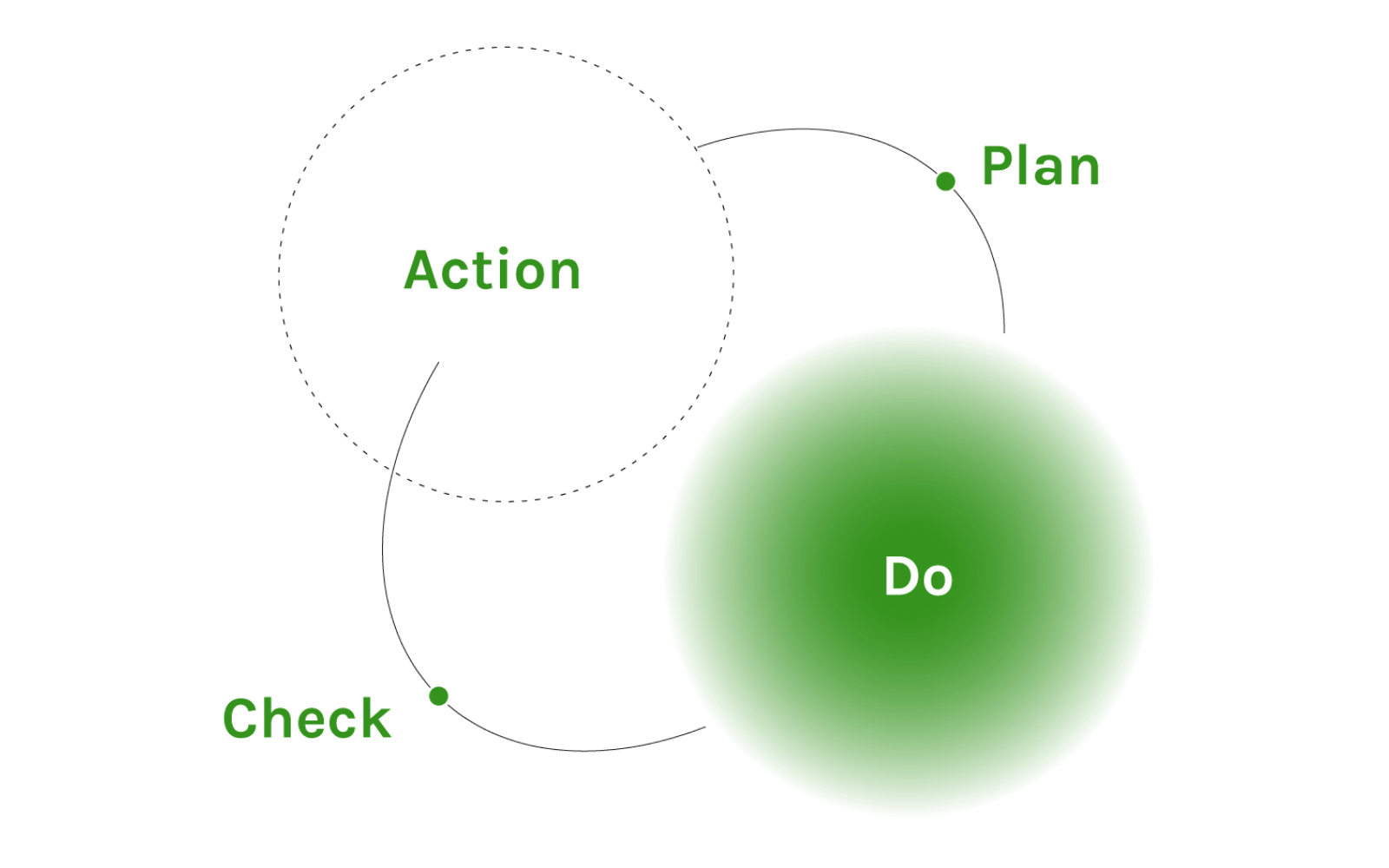
Closing the Integrity Cycle through the PDCA methodology
For integrity management, this cyclic logic provides a framework for connecting asset information, risk assessment, prioritization, intervention planning, and field execution. Rather than ending when an anomaly is identified, or an intervention is completed, the process continuously incorporates new information and changing asset conditions into subsequent decisions.
Vidya applies this principle to integrity management by combining automated analysis and prioritization with the industry’s operational knowledge and decision-making. In this approach, the cycle connects data orchestration and risk definition with massive anomaly detection, intervention planning, and field execution, creating a continuous loop through which integrity priorities can be reassessed and acted upon.
PLAN: Establishing the integrity logic
The cycle begins collaboratively between the industry and Vidya through a technical assessment of the asset, its available information, and its existing integrity-management practices. The objective is to establish the technical and operational context required to configure the cycle according to the specific characteristics and priorities of the facility.
The assessment considers available engineering and operational documentation, asset structure and hierarchy, inspection and maintenance history, existing integrity criteria, and the information required to support risk-based decisions. Previous inspection cycles can also be assessed to identify what has been addressed, what remains open, and what has changed in the condition of the asset. This provides a baseline for establishing how information should be organized, correlated, and evaluated within the platform.
From this assessment, Vidya and the industry collaboratively define the logic that will govern the subsequent stages. Business rules are configured, risk matrices are calibrated, relevant data is orchestrated, and inspection and prioritization criteria are established according to the organization’s integrity-management practices. The result is a configured decision framework grounded in its operational context, available data, and existing integrity rules.
DO: Massive anomaly detection and prioritization
With the integrity logic established, the DO phase moves from configuration to execution. This is where Vidya’s Digital Fabric Integrity (DFI) applies AI-driven analysis to inspection data at scale.
The process begins with Reality Capture campaigns, in which high-resolution visual data is systematically acquired across the asset to create a comprehensive representation of its physical condition. These campaigns generate the image datasets required for automated inspection, allowing DFI to analyze extensive areas of industrial facilities rather than relying solely on manually selected inspection points.
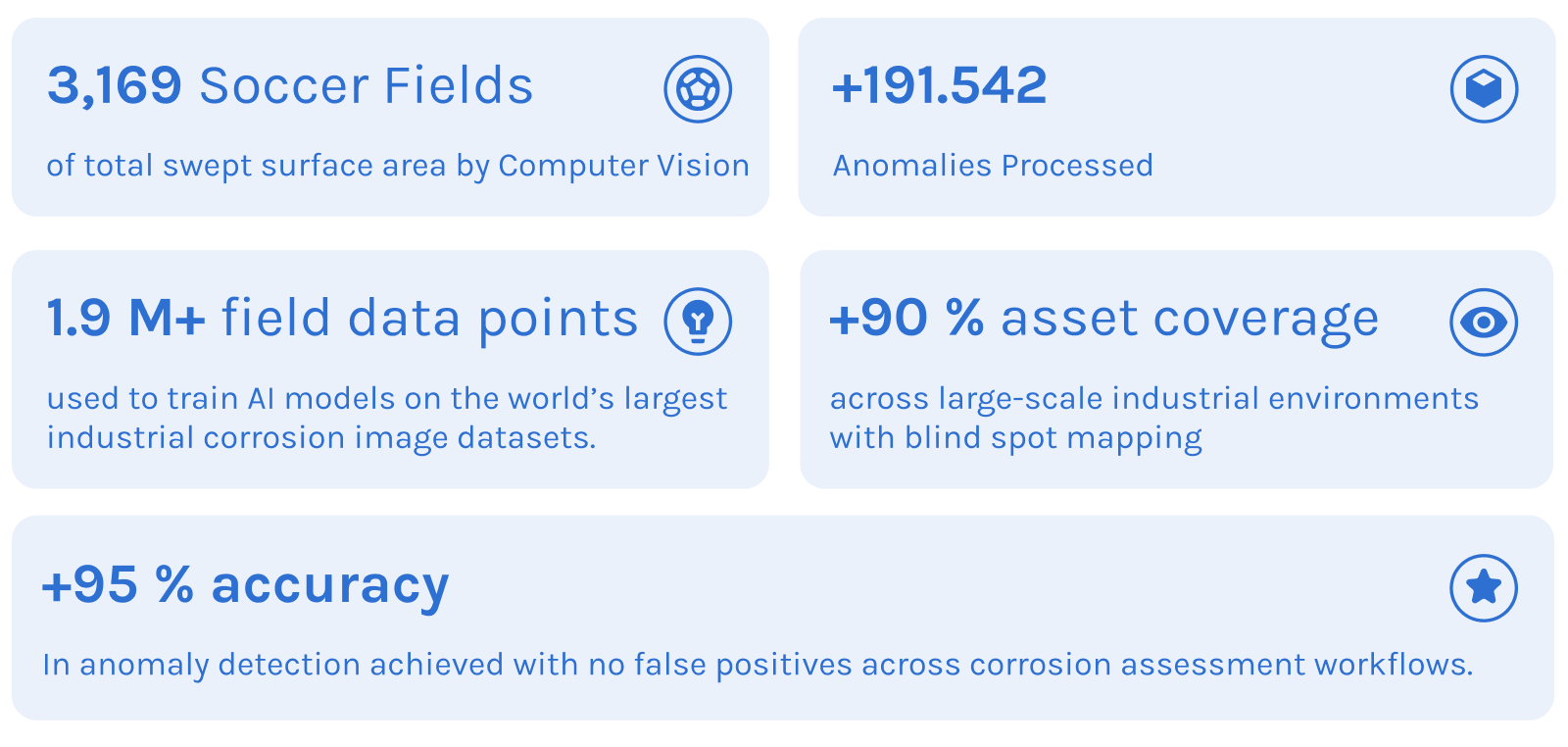
DFI uses proprietary computer vision models trained on the world’s largest corrosion dataset, developed from industrial inspection data collected across multiple assets and inspection campaigns. This dataset supports the identification of corrosion and other visual anomalies across large volumes of inspection imagery. The models can systematically screen the captured data, detecting anomalies at a scale that would be difficult to achieve through manual image-by-image review.
Detection, however, is only the first step. The findings generated by DFI are prioritized according to the business rules, risk criteria, and asset information established during the PLAN phase. This connects what the inspection reveals with the integrity logic defined by the organization, allowing large numbers of findings to be structured into a risk-oriented priority list. This approach operates at a scale that manual inspection cannot match, with millions of data points processed across extensive industrial environments:
CHECK: Translating priorities into intervention strategies
The CHECK phase brings the prioritized findings back into the hands of the industry. At this stage, the objective is to translate the priorities generated during the DO phase into concrete intervention strategies, considering the asset’s current condition, integrity KPIs, available resources, and operational constraints.
This is where Digital Fabric Maintenance (DFM) supports the transition from prioritized findings to maintenance planning. By connecting anomaly information with asset context and intervention requirements, DFM provides the industry with a structured environment to evaluate and define how each priority should be addressed.
The platform supports teams in outlining workpacks and intervention scopes, evaluating budget scenarios, planning coating activities, and defining intervention strategies for individual findings. As new diagnostic information becomes available, repairs can also be reassigned or their priorities revised, while current integrity KPIs can be used to reassess the intervention backlog and its alignment with the organization’s objectives.
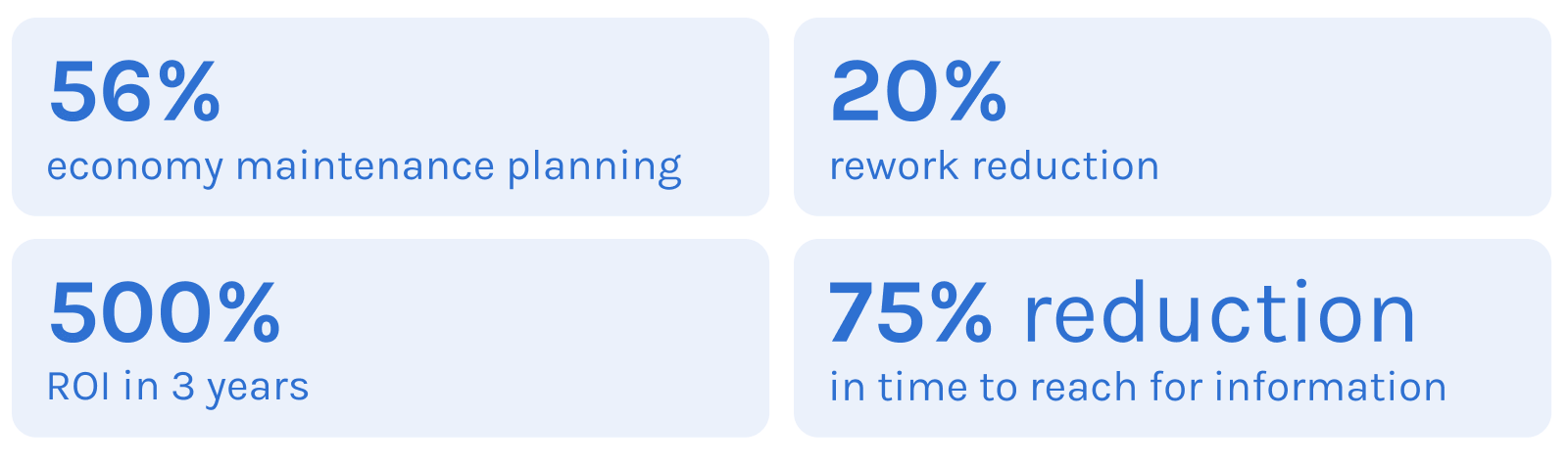
This creates a decision layer between automated detection and field execution. DFI identifies and prioritizes what requires attention; DFM helps organize what needs to be done and how it can be executed. The industry remains responsible for evaluating the available options and defining the intervention plan, while the platform provides the context and tools required to make those decisions based on the most current information available. The impact of this approach can be measured across planning efficiency, rework, return on investment, and access to information:
ACT: Taking integrity management to the field
The ACT phase is where the intervention strategies defined in the previous stage are executed in the field. Industry teams carry out the planned activities according to the established priorities, scopes, and intervention requirements.
Vidya supports this stage through a mobile application that brings the relevant integrity workflows directly to the field. Teams can use structured checklists and surveys to guide and document activities such as temporary repairs, non-destructive testing (NDT), EX inspections, and other integrity interventions. For difficult-to-access or connectivity-constrained areas, the application supports online-offline synchronization, allowing teams to continue recording information in the field without an active connection and synchronize the data once connectivity is restored. This provides a standardized way to record field observations, intervention results, and updated asset conditions while the work is being performed.
The objective is to maintain the connection between what was prioritized, what was planned, and what was actually executed. Field information can be associated with the corresponding asset and intervention, providing a record of the action taken and the condition observed at the time of execution.
And the cycle does not end with field execution. Results from interventions, new inspection campaigns, updated asset conditions, and operational changes provide new information for the next planning cycle. This closes the loop between planning, automated detection, intervention management, and field execution, allowing integrity priorities to be continuously reassessed as the condition of the asset evolves.
Conclusion
Securing integrity at scale is ultimately not a matter of collecting more data or detecting more anomalies, but of maintaining a continuous connection between what is known about an asset and what is done about it. A cyclic approach makes this possible by allowing inspection data, risk criteria, operational decisions, and field results to continuously inform one another. By combining the industry’s technical and operational expertise with Vidya’s capabilities for data orchestration, AI-driven detection and prioritization, intervention planning, and field execution, the integrity process can evolve with the asset rather than remain tied to isolated inspection campaigns or maintenance activities.
About the Author: Jorge Kawano